
.png)
What Is a CRM System and When Do SMEs Need One?
Summary: A Customer Relationship Management (CRM) system is software that helps businesses manage customer relationships, track sales pipelines, and organise interactions across marketing and sales channels. SMEs typically need a CRM when spreadsheets and manual processes can no longer handle growing customer data and sales activity.
For many SMEs, the challenge is not understanding that CRM is useful. The challenge is knowing when to adopt one, how to choose the right platform, and how to implement it effectively.
This guide explains the fundamentals of CRM systems and the key decisions SMEs in Singapore should consider when adopting their first CRM.
Table of Contents
- What Is a CRM System?
- When Do SMEs Actually Need a CRM?
- Is a CRM better than spreadsheets?
- What is the difference between CRM and ERP?
- CRM Adoption in Singapore
- How do you Calculate CRM ROI
- What common mistakes should SMEs avoid?
- Which CRM platforms are best for SMEs?
- What does CRM implementation involve?
- How can I clean up messy data?
- How much does a CRM cost?
- Conclusion
What Is a CRM System?
A Customer Relationship Management system is software designed to manage interactions with leads, prospects, and existing customers.
How does a CRM software work?
A CRM brings everything into a single platform where teams can:
- Store contact and company records
- Track sales pipelines and deal stages
- Log communication history across emails, calls, and messages
- Automate follow-ups and workflows
- Generate reports and analyse sales performance
The main goal of a CRM is not simply storing data. It is helping businesses build a consistent and scalable process for managing customers and generating revenue.
→ For a deeper explanation of CRM systems and how they work, read our guide on "What Is CRM Software? Guide for SMEs".When Do SMEs Actually Need a CRM?
SMEs need a CRM when customer data becomes difficult to manage across spreadsheets, communication channels, and sales processes.
Many businesses begin managing customers using spreadsheets, email, or messaging apps. This approach works during the early stages when customer volumes are small and sales processes are simple. However, growth eventually introduces operational challenges.
Common signs that a business may need a CRM include:
- Leads being tracked in multiple spreadsheets
- Customer conversations happening across different communication channels
- Limited visibility into the sales pipeline
- Inconsistent follow up with prospects
These problems indicate that customer data and sales activity are no longer easy to manage manually.
It may slow your business down if you are still sitting on the fence, holding out until the last moments where your previous system no longer works to purchase a CRM system. Adopting a CRM earlier rather than later is often beneficial, as implementation takes time and requires alignment with internal workflows.
If you are unsure whether your organisation has reached this stage, read our article on "When Should SMEs in Singapore Switch from Excel to a CRM?"
.png?width=1270&height=720&name=Blog%2010%20Graphic%20(3).png)
Is a CRM better than spreadsheets?
Key takeaway: Spreadsheets work well for early stage lead tracking, but once teams begin handling larger volumes of customers or sales opportunities, a CRM provides the structure needed to manage relationships consistently.
They are often the first tool businesses use to track leads and customer data. They are flexible, familiar, and quick to set up. However, spreadsheets were not designed to manage customer relationships at scale.
As businesses grow, teams often encounter problems such as:
-
Duplicated customer records
-
Difficulty tracking conversation history
-
Manual updates that create errors
-
Limited collaboration between team members
CRM systems address these challenges by structuring customer data and automatically recording interactions across sales activities.
What is the difference between CRM and ERP?
CRM systems manage customer relationships and sales processes, while ERP systems manage broader business operations such as finance, inventory, and supply chain.
CRM and ERP systems are often mentioned together, which can create confusion for businesses exploring digital tools.
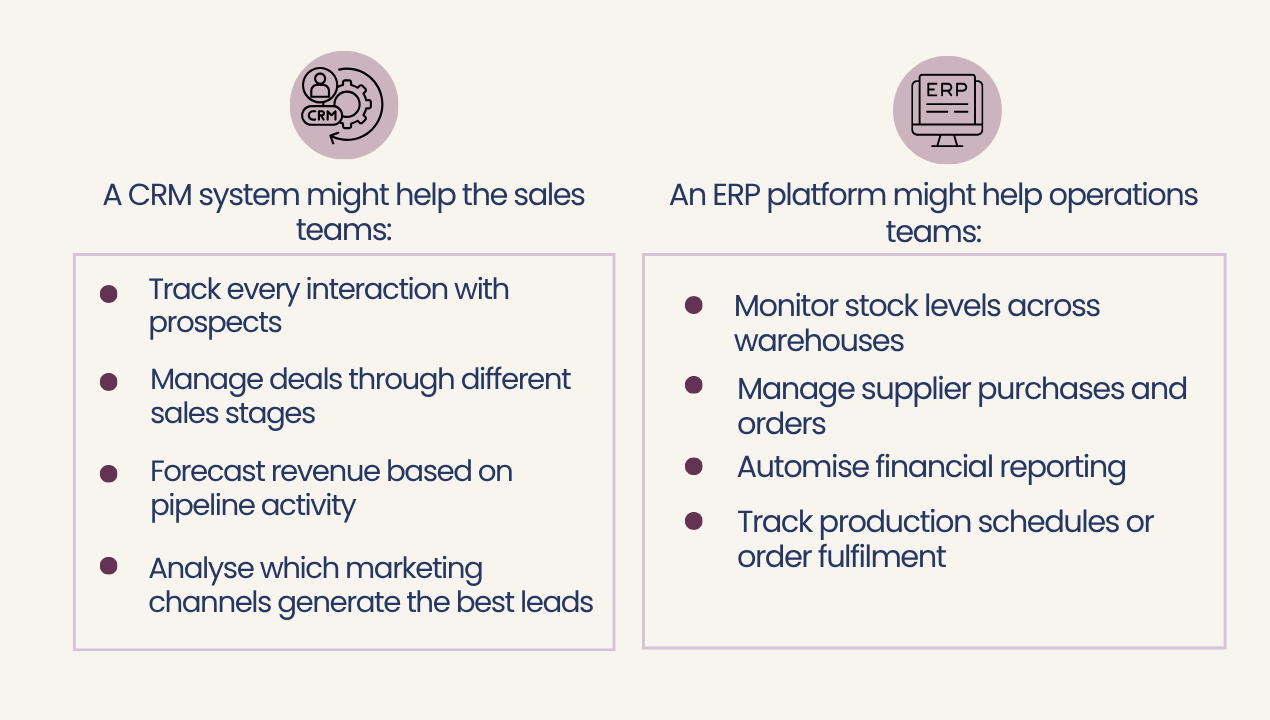
Most SMEs adopt a CRM before an ERP because customer management becomes complex earlier in the growth journey. Both systems can be integrated, but they serve different purposes.
→ If you would like a detailed breakdown of when businesses need CRM, ERP, or both, read our guide on CRM vs ERP for SMEs.
CRM Adoption in Singapore: What SMEs Should Know
CRM systems are becoming essential for SMEs in Singapore to manage sales and customer relationships effectively. Several factors are driving adoption such as increasing competition across industries and
the need for faster response times to customer enquiries.
.png?width=1270&height=720&name=Blog%2010%20Graphic%20(2).png)
How to Calculate CRM ROI
CRM ROI is calculated by measuring the increase in revenue, time savings, and improvements in sales efficiency after implementation.
One reason some businesses hesitate to adopt CRM software is uncertainty about return on investment. However, the value of CRM systems often appears across several areas of the business.
A CRM can improve revenue performance by:
• Increasing lead conversion rates
• Reducing the length of the sales cycle
• Improving customer retention
• Reducing manual administrative work for sales teams
For example, when follow ups are automated and sales activity is tracked consistently, fewer opportunities fall through the cracks.
A simple ROI framework looks at three areas:
• Additional revenue generated from improved conversion
• Time saved through automation
• Improved forecasting and decision making
When these factors are considered together, CRM systems often deliver measurable business impact.
→ Check out our simple CRM implementation calculator for HubSpot CRM here. (Scroll down the webpage to view the ROI Calculator)
Common CRM Mistakes SMEs Should Avoid
CRM systems can transform how businesses manage customers, but only when implemented thoughtfully.
Some of the most common mistakes include:
- Choosing CRM software based only on price
- Overcomplicating the system with unnecessary customisation
- Failing to train teams properly
- Not integrating CRM with communication channels
- Treating CRM as a one-time implementation
- Poor CRM data hygiene and inconsistent records
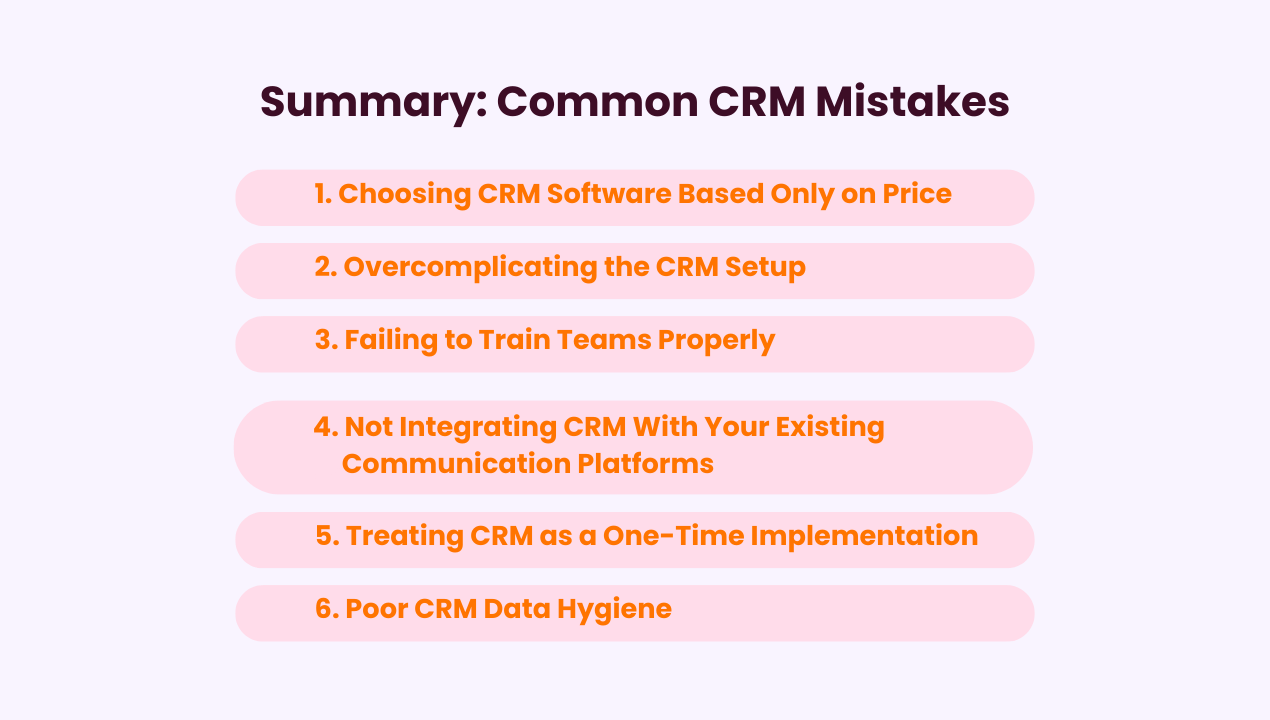
Avoiding these mistakes helps ensure the CRM becomes a tool that supports growth rather than an unused platform.
→To learn more about Common CRM Mistakes, check out our detailed article here.
Which CRM platforms are best for SMEs?
The best CRM platform depends on your business size, sales complexity, and growth plans.
Once a business decides to adopt a CRM system, the next challenge is choosing between the many platforms available. Different CRM solutions are designed for different types of organisations, sales processes, and levels of complexity.
Some platforms focus on ease of use and fast setup, while others provide advanced automation and enterprise level customisation.
SMEs evaluating CRM software often compare several major platforms, including:
- Monday.com
- Salesforce
- HubSpot
- Microsoft Dynamics 365
- Insightly
- Zoho CRM
There is no single “best CRM”. The right platform depends on your team size, growth plans, and how complex your sales and customer management processes are.
If you want a detailed breakdown of the strengths, limitations, and ideal use cases for each platform, read our full guide: CRM Comparison 2026: Monday.com vs Salesforce vs HubSpot vs Dynamics 365 vs Insightly vs Zoho
What does CRM implementation involve?
Implementing a CRM involves aligning the system with your sales processes, data, and workflows. SME implementations are usually phased:
- Discovery and planning – Define sales process, data needs, and goals
- System setup – Configure pipelines, properties, and workflows
- Data migration – Import and clean existing customer data
- Training and adoption – Ensure teams know how to use the system
- Optimisation – Refine processes after rollout
→You can learn more about what happens during CRM implementation in this article: HubSpot Onboarding Services: What’s Included, Pricing, and Timeline
Working with an experienced implementation partner such as NetFarmer can help ensure your CRM is correctly set up and aligned with your business goals.
How to Clean up Messy data in your CRM?
If you are struggling with inconsistent data, unfilled properties and unknown contacts, it is probably a good time to sit down and clean up your customer data.
It is good practice to always prepare your data before you migrate to a new system, and practice CRM Hygiene by reviewing issues periodically.
CRM data migration is the process of transferring customer data, sales data, and marketing data from legacy systems into a new CRM system such as HubSpot or Salesforce.
CRM hygiene is the ongoing practice of maintaining CRM data quality through structured processes such as deduplication, standardisation, and governance.
-
CRM data migration = foundation of CRM implementation
-
CRM hygiene = ongoing CRM data quality management
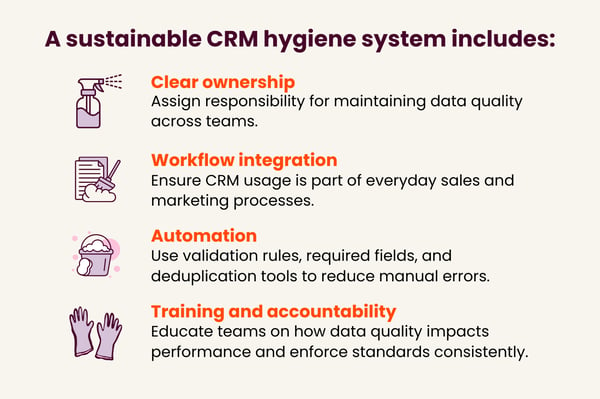
→ Learn more about fixing and maintaining data quality in this article: Fixing Messy Customer Data in Your CRM|Data Migration and CRM Hygiene
How much does a CRM cost?
CRM pricing varies depending on the platform, features, and number of users. Most CRM providers offer subscription based pricing where businesses pay a monthly fee per user.
Common pricing models include:
- Free plans with limited functionality
- Tiered subscriptions that unlock more advanced features
- Enterprise plans designed for larger organisations
While subscription pricing is the most visible cost, businesses should also consider the broader investment involved in adopting a CRM. This can include implementation support, data migration, and team training.
For a more detailed look at roughly how much a CRM such as HubSpot costs, refer to our related article on "HubSpot Implementation Cost in Singapore (2026 Pricing Breakdown for SMEs in Singapore)".
Conclusion
If you are exploring CRM adoption, the guides linked throughout this article provide deeper insights into each stage of the journey, from choosing the right system to implementing it effectively.
For many SMEs, managing customers starts with simple tools such as spreadsheets and email. Over time, those systems become difficult to scale as sales activity grows and customer interactions become more complex.
Selecting the right platform and implementing it successfully requires careful planning. Businesses should evaluate their needs, understand the full cost structure, and design processes that support their teams. Schedule a call with NetFarmer to understand how we can help you streamline this journey with HubSpot.
.png)