.png)
What Is the Difference Between CRM and ERP?
A CRM (Customer Relationship Management) system manages customer interactions, sales pipelines, and marketing activities. An ERP (Enterprise Resource Planning) system manages internal business operations such as finance, inventory, procurement, and supply chains.
In simple terms:
- CRM drives revenue growth by improving customer relationships
- ERP drives operational efficiency by managing internal resources
Most growing businesses eventually need both, but they serve different purposes at different stages of growth. Understanding the difference between CRM and ERP helps you make the smarter choice, by investing in systems that resolve your most pressing operational challenges.
What You’ll Learn
This article explains:
- What CRM and ERP systems are
- How they differ in function and outcomes
- The type of data each system manages
- Whether businesses need both systems
- Which system SMEs should prioritise first
- Frequently asked questions (FAQ) on CRM vs ERP
What Is the Main Difference Between CRM and ERP?
The key difference between CRM and ERP systems lies in what they are designed to manage.
| Feature | CRM Software | ERP Software |
| Main focus | Customer relationships and revenue | Internal operations and resources |
| Primary users | Sales, marketing, support | Finance, operations, HR |
| Core data | Leads, contacts, deals, communication history | Inventory, finance, procurement |
What Does a CRM System Do?
A CRM system helps businesses organise and improve interactions with customers and prospects. It centralises customer information and supports the entire customer lifecycle, from lead generation to post-sale support. If you are unfamiliar with the concept, this guide explains what a CRM system is and how businesses use it.
CRM platforms such as HubSpot and Salesforce are commonly used to:
- Store and manage customer and company data
- Track leads, deals, and sales pipelines
- Record emails, calls, and meeting history
- Automate marketing campaigns and follow-ups
- Manage customer service tickets
- Generate reports on sales performance and revenue forecasts
Because CRM platforms focus on revenue and customer engagement, they are primarily used by:
- Sales teams
- Marketing teams
- Customer support teams
What Does an ERP System Do?
An ERP system, by contrast, focuses on internal business processes and resource management. ERP platforms help organisations manage internal operations and business processes by centralising operational data.
ERP platforms such as SAP and Oracle NetSuite typically support:
- Financial accounting and reporting
- Procurement and supplier management
- Inventory and warehouse tracking
- Manufacturing and production planning
- Supply chain coordination
- Human resources and payroll
ERP systems are mainly used by:
- Finance teams
- Operations teams
- Administrative departments
How Do CRM and ERP Differ in Outcomes?
Another way to understand the difference between CRM VS ERP is by looking at what each system helps you achieve.
CRM drives growth
CRM platforms are designed to help businesses generate and grow revenue. By centralising customer data and sales activity, they allow teams to track opportunities, manage pipelines, and build stronger customer relationships.
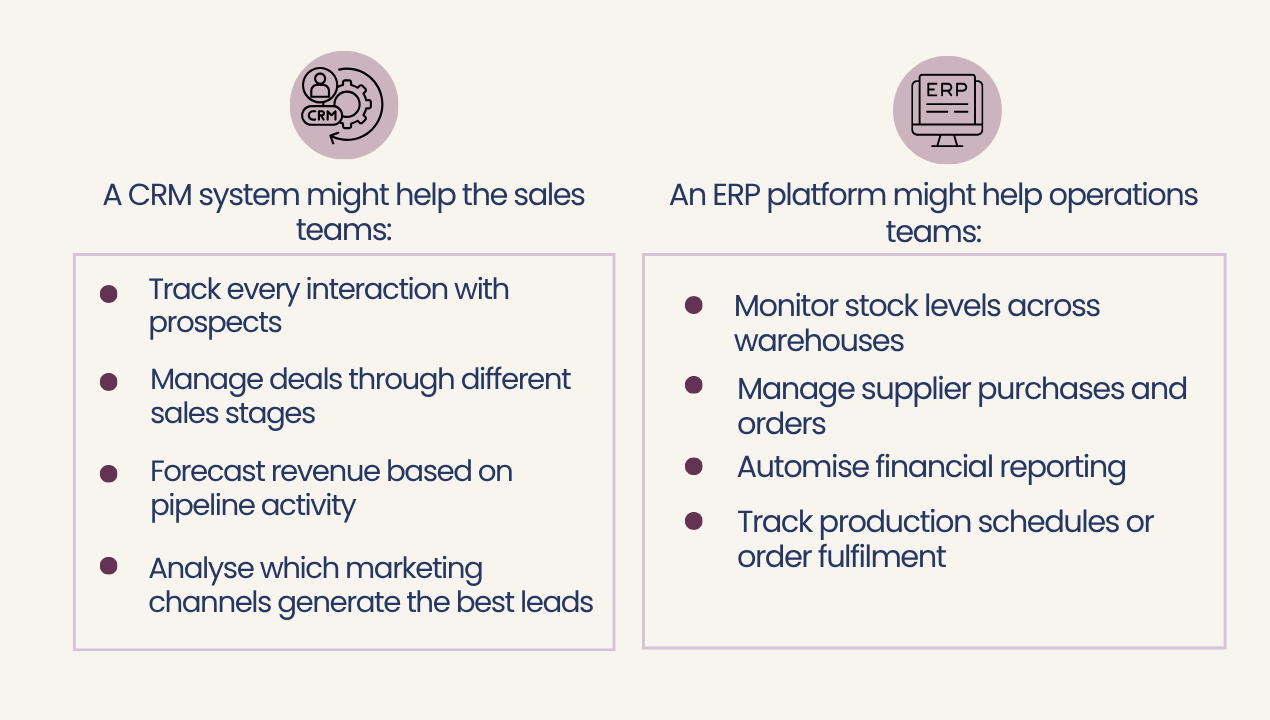
CRM systems help businesses:
- Track every interaction with prospects
- Manage deals through structured pipelines
- Forecast revenue based on real-time data
- Identify high-performing marketing channels
They are designed to increase revenue and improve customer retention.
Marketing teams can also use CRM data to segment audiences, personalise campaigns, and measure marketing performance.
ERP drives efficiency
ERP systems, on the other hand, are designed to ensure internal processes run efficiently and accurately. They provide operational visibility and help organisations control costs and resources.
ERP systems help organisations:
- Monitor inventory and supply levels
- Automate financial reporting
- Manage procurement and supplier relationships
- Track production and fulfilment processes
They are designed to reduce costs, improve accuracy, and streamline operations.
Quick summary:
- CRM helps businesses win and retain customers.
- ERP helps businesses manage resources and deliver products or services efficiently.
Most growing organisations eventually need both systems.
What Type of Data Do CRM and ERP Systems Manage?
CRM and ERP systems also differ in the type of data they manage.
CRM manages customer and relationship data
They capture every interaction between the business and its customers, helping teams understand the customer journey and sales pipeline.
Typical CRM records include:
- Customer and company profiles
- Marketing engagement data
- Sales conversations and meeting notes
- Support tickets and service history
- Purchase or contract details
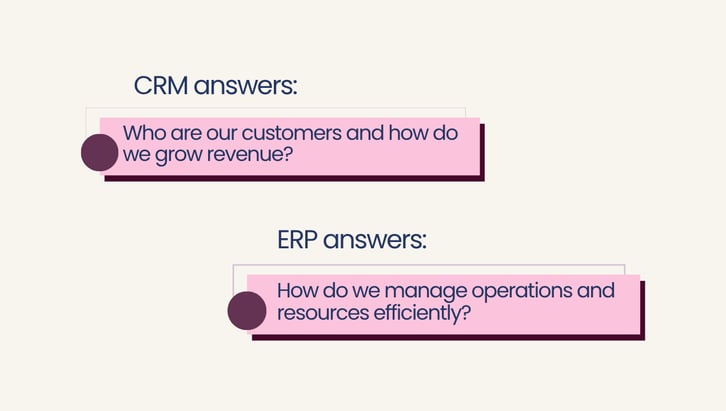
This data helps businesses understand who their customers are and how relationships evolve over time.
ERP manages operational and transactional data
Typical ERP records include:
- Financial transactions and accounting data
- Purchase orders and invoices
- Inventory quantities and stock movements
- Supplier information
- Production or fulfilment schedules
This ensures internal operations run accurately and efficiently.
For example, a manufacturing company might use a CRM system to manage distributor relationships and sales opportunities, while its ERP system tracks raw materials, production schedules, inventory levels, and invoicing.
In simple terms:
Do Businesses Need Both CRM and ERP?
In many cases, yes.
As businesses grow, CRM and ERP systems become more valuable when integrated.
In many organisations, customer-facing teams work primarily in CRM systems while finance and operations rely on ERP platforms. If these systems remain separate, information gaps often appear between departments.
For example:
- Sales teams may not know whether products are available in stock
- Finance teams may manually re-enter customer data
- Customer support may lack visibility into order status or invoices
Integrating CRM and ERP systems helps eliminate these silos and create a more complete operational view.
When integrated, CRM and ERP systems allow:
-
Seamless data flow between customer-facing and operational teams
-
Better forecasting across sales and finance
-
Improved customer experience with accurate, real-time information
For example, a company may use a CRM like HubSpot or Salesforce to manage sales pipelines, while using an ERP like SAP or Oracle NetSuite to handle inventory, invoicing, and financial reporting. For growing companies, this integration often marks the shift from disconnected tools to a fully connected business system.
Implementing a CRM system typically involves configuration, data migration, and team training. If you are interested in learning more about HubSpot, you may want to understand what HubSpot CRM onboarding services include, along with typical costs and timelines.
Which Should SMEs Choose First: CRM or ERP?
For most small and medium-sized businesses, the answer is CRM first. CRM and ERP systems are sometimes compared as if they compete with each other, but in reality they address different layers of business operations.
Start with CRM if you need to:
- Manage growing leads and customer relationships
- Track sales pipelines and revenue
- Improve marketing performance and visibility
Consider ERP when you need to:
- Manage complex financial processes
- Handle inventory, logistics, or supply chains
- Improve operational efficiency at scale
Practical insight:
Many SMEs in Singapore adopt CRM early because customer acquisition becomes complex before operations reach ERP-level complexity.
Ultimately, businesses that integrate both systems gain a clearer view of customers, operations, and financial performance, allowing them to make better strategic decisions as they grow.
Final Thoughts: Choosing the Right System for Your Business
CRM and ERP systems are often compared, but they solve different business challenges.
- A CRM system helps you win and retain customers
- An ERP system helps you deliver products and manage resources efficiently
Businesses that successfully implement and integrate both systems gain full visibility across revenue, operations, and financial performance, enabling better decision-making as they scale.
If you are evaluating CRM options, you may also want to explore "How to choose the right CRM for your SME" to ensure the platform aligns with your business goals.
Frequently Asked Questions on CRM VS ERP:
Is CRM part of ERP?
No. CRM and ERP are separate systems, although some ERP platforms include CRM modules. In most cases, businesses use them as integrated but distinct systems.
Can small businesses use both CRM and ERP?
Yes, but most SMEs start with CRM and adopt ERP later as operations become more complex.
Which is more important, CRM or ERP?
It depends on your business stage.
-
Early-stage: CRM is usually more critical
-
Scaling stage: ERP becomes equally important
.png)