Implementing HubSpot CRM involves more than buying software. Costs include the subscription and any onboarding needed to ensure your team uses it effectively. In Singapore, licences range from Starter plans for small teams to enterprise-level packages, with onboarding designed to maximise value.
This guide breaks down:
- HubSpot implementation cost in Singapore for SMEs
- How much HubSpot software costs in Singapore
- HubSpot onboarding costs and what you actually pay for
- HubSpot partner costs in Singapore and whether you need one
- Additional fees in customisation add-ons and scaling
- The cost of HubSpot misconfiguration and how to avoid it
- Budget friendly HubSpot options for SMEs
- Final Thoughts And Frequently Asked Questions (FAQ)
Summary: HubSpot Costs at a glance
Pricing Overview (as of April 2026):
|
Starter Plan |
Professional Plan |
Enterprise Plan |
|
SGD 28 to 68 per user per month |
SGD 63 to 1,300 per month |
SGD 105 to 2,800 per month |
|
Limited automation |
Advanced automation |
Advanced permissions |
|
Basic reporting |
Custom reporting |
Revenue attribution |
|
No onboarding provided |
Required onboarding |
Required onboarding |
First-year investment for SMEs: SGD 8,000–60,000+ depending on plan, user count, automation, and partner involvement.
1. HubSpot Implementation Cost for SMEs
For most small and medium-sized businesses in Singapore, first-year investment in HubSpot typically range from SGD 8,000 to SGD 60,000, depending on:
- HubSpot plan and features (Starter, Professional, Enterprise)
- Complexity of your business processes
- Number of users and marketing contacts
- Depth of automation needed
- Integration with other business systems
- Partner support and consultancy
In practice, you will get a quote from either the HubSpot team or your chosen HubSpot Solutions Partner after providing extra details such as your industry, scope, and needs. These total costs combine subscription fees, onboarding, and any advisory support needed to optimise sales, marketing, and operations.
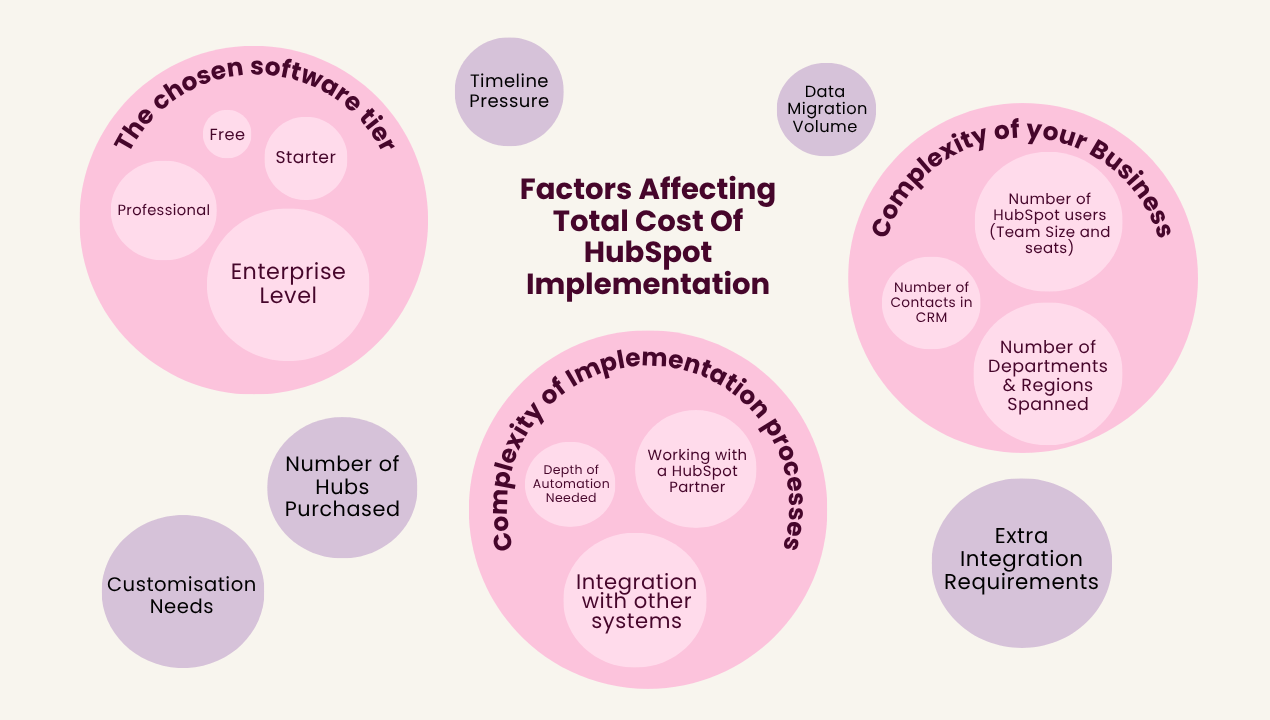
Understanding these variables early allows businesses to plan strategically and ensure every dollar spent is invested n tools and services that directly support your growth
2. How much is HubSpot software priced in Singapore?
HubSpot operates in a subscription based model, where businesses pay according to the number of users on the platform. Each user is assigned a “seat” (HubSpot account), with pricing calculated on a per-seat, per-month basis. HubSpot offers multiple hubs tailored to different business functions, each available in Starter, Professional, and Enterprise tiers. These include: Marketing Hub, Sales Hub, Service Hub, Operations Hub, Content Hub, Data Hub, and Commerce Hub.
Typical Pricing Overview (as of April 2026):
|
Starter Plan |
Professional Plan |
Enterprise Plan |
|
SGD 28 to 68 per user per month |
SGD 63 to 1,300 per month |
SGD 105 to 2,800 per month |
|
Limited automation |
Advanced automation |
Advanced permissions |
|
Basic reporting |
Custom reporting |
Revenue attribution |
|
No onboarding provided |
Required onboarding |
Required onboarding |
For the latest HubSpot software pricing, see HubSpot’s official pricing page: https://www.hubspot.com/pricing
For small businesses, HubSpot’s Starter plans are budget-friendly, starting at SGD$28 per user per month. For example, a sales team of 20 people, along with one manager, would require a total of 21 seats.
Note: Subscription fees cover the software licence only. Implementation costs, which include setup, training, and configuration, are separate.
3. HubSpot onboarding costs and what you actually pay for
Onboarding is designed as the "training wheels" to help your team use HubSpot effectively.
→ Learn more about the differences between HubSpot Onboarding, Implementation and Training here.
This reduces the need for rework and enabling you and your team to unlock the platform’s full potential. A well-structured onboarding ensures that sales, marketing, and business operations are fully aligned from the start. You can complete onboarding directly through HubSpot or via a certified HubSpot Solutions Partner, such as NetFarmer.
Professional and Enterprise plans require one-time onboarding fees, which cover:
- Initial setup of the system
- Pipeline and workflow configuration
- Introductory training for your team
Onboarding Fees pricing table:
|
Plan Level |
Approx. One‑Time Onboarding Fee (SGD) |
|
Marketing Hub Professional |
SGD 4,200 |
|
Sales/Service Hub Professional |
SGD 2,100 each |
|
Marketing Hub Enterprise |
SGD 9,800 |
|
Sales/Service Hub Enterprise |
SGD 4,900 each |
|
Customer Platform Professional |
SGD 14,000 |
|
Customer Platform Enterprise |
SGD 23,800 |
|
Customer Platform Premier |
SGD 33,600 |
|
Figures sourced from recent HubSpot pricing data (Wise) |
** It’s important to note that onboarding focuses on training your staff and guiding them through the platform, while having a HubSpot Partner configure everything for you is a separate service.
Onboarding typically covers initial setup, basic pipeline configuration, and introductory training. For example, a Marketing Hub Professional plan may involve around SGD 4,200 upfront before using advanced marketing automation workflows.
To understand more on HubSpot Partners and onboarding, see our article on "Choosing the right HubSpot Onboarding Partner" here.
4. Partner Costs and Benefits
Certified HubSpot partners bring experience and expertise that can prevent costly mistakes. Partner support often includes onboarding workshops, workflow optimisation, advanced integrations, customisation, and change management, which can accelerate ROI and reduce internal workload.
Common partner pricing models in Singapore:
-
Fixed Project Fee: One-time cost for a defined scope of work such as setup, migration, basic workflows, and training.
-
Phased Implementation: Payment staged over multiple phases for multi-hub or complex setups.
-
Hourly or Day Rate: Charged for technical support, training sessions, or small customisation work beyond the agreed upon implementation or onboarding.
-
Monthly Retainer / Growth-Driven Optimisation: Ongoing optimisation, reporting, and workflow updates, usually for enterprise clients.
Indicative costs in Singapore:
-
Small SMEs – Single hub, one or two pipelines, minimal automation, and basic reporting: SGD 3,000 to 8,000, often as a fixed project fee including onboarding.
-
Medium-sized businesses – Multiple hubs, several pipelines, moderate automation, and integrations: SGD 8,000 to 20,000, covering custom workflows, dashboards, and team training.
-
Large or enterprise organisations – Multi-hub setups, advanced automation, multi-country operations, extensive integrations, and full team training: starting around SGD 20,000, with complex projects reaching SGD 50,000 or more.
Disclaimer: These figures are indicative market ranges based on publicly available data and observed partner pricing trends in Asia. A consultation with a certified HubSpot partner, such as NetFarmer, is recommended to obtain a tailored quote for your business industry and CRM needs.
5. Hidden Implementation costs: Customisation and Long-Term Costs to Consider
Beyond subscription and onboarding, many SMEs underestimate how CRM implementation costs evolve over time. Planning ahead ensures that these costs support growth rather than creating surprises later.
Customisation and Add-On Costs in HubSpot
As your processes become more sophisticated, you may need features that go beyond your initial plan, such as:
- Third-party integrations
Connecting HubSpot to tools such as ERPs, ad platforms, or data warehouses may involve partner integration fees, middleware tools, or developer support. - Extra add-ons
Additional functionality within Marketing, Sales, or Service Hubs such as lists limit, ad limit and reporting limit increase, can be unlocked through paid add-ons rather than full upgrades. - Marketing contact tier upgrades
HubSpot charges based on the number of marketing contacts. As your contact database grows, you may need to purchase higher contact tiers, which can significantly increase monthly costs over time. - HubSpot Credits
They are pre-purchased units that businesses can use to access specific paid features or add-ons without immediately upgrading to a higher subscription tier. They give flexibility to unlock additional functionality as needed, rather than committing to a full plan
These costs scale incrementally, allowing you to invest only in the features your business actively needs.
Planning for Long-Term HubSpot Investment
HubSpot is designed to grow with your business, so costs will naturally scale alongside your team and operations:
- Scaling team usage
Adding more users across sales, marketing, and service teams increases licence costs, especially on higher-tier plans. - Ongoing partner or support fees
Many businesses continue working with partners post-implementation for optimisation, reporting, and system improvements, which adds to long-term investment. - Reconfiguration for growth
As your business expands into new markets or adds new revenue streams, your HubSpot setup may need to be restructured, leading to additional costs.
Well planned implementations align your initial setup with future growth, helping you scale efficiently while avoiding unnecessary spend. Without this foresight, businesses often end up paying more later to fix or rebuild their system.
6. The Cost of Misconfiguration
Even with a powerful platform like HubSpot, the way it is set up determines the value you get from it. Missteps during implementation can lead to issues such as:
- Incorrect lifecycle stage mapping
- Overcomplicated pipelines
- Poor property structure
- Broken automation logic
- Inflated marketing contact counts
- Inaccurate reporting dashboards
Left unaddressed, these can impact deal visibility, forecasting accuracy, and marketing attribution, making it harder for teams to act on reliable insights.
The good news is that these are entirely avoidable with the right planning and setup. Establishing a clear data structure, keeping workflows streamlined, and aligning teams early ensures HubSpot remains a reliable source of insight and growth.
→ For a deeper look at what to watch out during implementation, you can explore our guide "6 Common CRM mistakes."
7. Choosing Budget-Friendly HubSpot Options for SMEs
Not every business needs to invest heavily in HubSpot from day one. In fact, many SMEs can start small and scale gradually as their processes mature and their teams grow. A large upfront investment is rarely necessary.
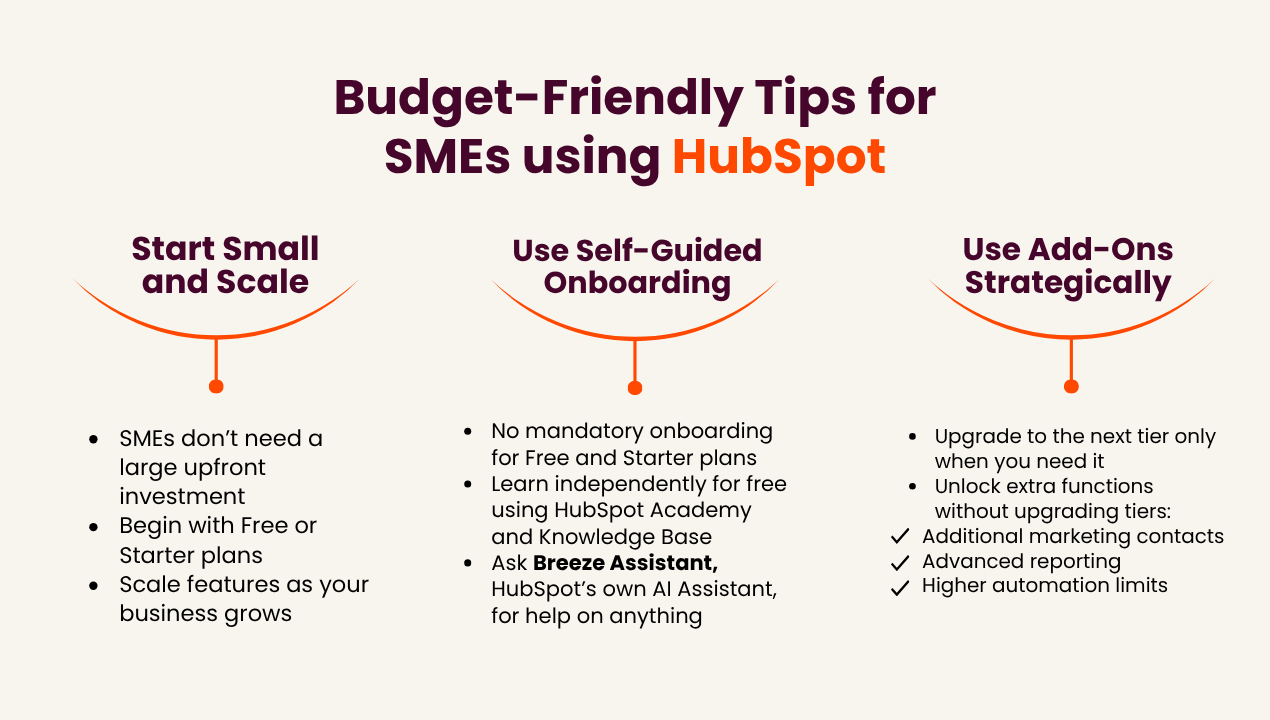
Start small and scale
HubSpot’s tiered structure is designed for this approach. For early-stage or lean teams, the free version of HubSpot often provides enough functionality to get started. This includes:
- Contact and deal management
- Basic pipeline tracking
- Email tracking and templates
- Simple reporting dashboards
At this stage, clarity and consistency matter more than complexity. The starter plans provide the core tools you need to manage contacts, track deals, and run basic marketing or sales activities. By starting with the essentials, you invest in tools that directly support your growth without paying for functionality you won’t use.
If you are looking for something a step further, they have a Starter Bundle for Small Businesses, which is a limited time bundle offer of the starter edition of each HubSpot product. This starts at USD$9 per seat, per month which is a very affordable option for small businesses and teams.
Use Self-guided Onboarding
For smaller teams using HubSpot Starter or the Small Business Bundle, self-guided onboarding is often sufficient. HubSpot’s Knowledge Base and HubSpot Academy provide structured, practical guidance, allowing teams to implement as they learn. This keeps initial costs lean while ensuring the platform is set up with intent.
Use Add-Ons Strategically
HubSpot allows businesses to purchase add-ons without moving to a higher tier immediately. This can be a cost-effective way to unlock specific capabilities, such as:
- Additional marketing contacts
- Advanced reporting
- Increased automation limits
This gives SMEs more control over costs while still expanding when needed.
Over time, upgrading becomes a natural step when efficiency starts to take a hit. By that stage, the added investment is directly tied to productivity gains and business growth.
Upgrading becomes worthwhile when manual processes begin to slow your team down or create inconsistencies. At this point, the cost of staying on a lower tier often outweighs the investment in upgrading.
8. Final thoughts on HubSpot Implementation costs
HubSpot offers a flexible and scalable CRM platform that can adapt to the needs of growing businesses. From cost-effective starter plans to more advanced capabilities, the key is not how much you invest upfront, but how well the platform is implemented and aligned with your operations.
If you are planning to adopt or optimise HubSpot, NetFarmer can help you implement and scale it effectively. Get in touch with NetFarmer to explore how HubSpot can be tailored to your business and growth plans.
For SMEs in Singapore, a focused, phased approach keeps costs efficient while building a strong foundation for scale. With the right structure in place, HubSpot becomes a powerful driver of consistent, measurable results.
Frequently Asked Questions on HubSpot Pricing(FAQ)
What is the best HubSpot plan for SMEs?
Start with the free CRM or Starter plans, which cover core contact management, pipeline tracking, and basic reporting. Upgrades to Professional or Enterprise tiers can be added strategically as your business grows.
How much does HubSpot implementation cost in Singapore?
For most SMEs, first-year costs typically range from SGD 8,000 to SGD 60,000+, combining software, onboarding, and any advisory or partner support. The final figure depends on your setup complexity, number of users, and level of automation or integrations required.
Is HubSpot worth it for small and medium sized businesses (SMEs) in Singapore?
Yes. HubSpot provides a scalable, all-in-one CRM solution that supports sales, marketing, and service operations. With flexible plans, SMEs can start small and expand as needed, making it a cost-effective tool for growth.
Can I implement HubSpot without a partner?
Yes, many businesses start independently, especially with for smaller businesses and teams. HubSpot provides extensive resources in their Knowledge Base to support this. As requirements become more complex, bringing in a partner can help streamline implementation and ensure the best optimisation for your business needs.
How can I get the most out of HubSpot in Singapore?
Start with the features you need, maintain clean data, and adopt structured onboarding. Partner support from certified providers like NetFarmer can further optimise workflows, integrations, and reporting for maximum impact.
.png)
.png)