Quick Answer:
Xiaohongshu leads are converted into revenue by capturing direct message enquiries into a CRM system, qualifying them through structured workflows, and routing them to the appropriate sales teams for follow-up. Without this system, high-intent conversations remain scattered across inboxes and fail to translate into measurable business outcomes.
What Is XiaoHongShu?
Xiaohongshu (XHS), also widely known as Rednote, is a top Chinese-speaking discovery platform which acts as a powerful source of high-intent leads. Likewise, Singapore brands can leverage Rednote’s influence amongst Chinese speaking communities in Mainland China and the broader Chinese audience in Asia.
Unlike many social networks where users scroll passively, they actively look for genuine experiences, product reviews, and trusted recommendations. This type of behaviour signifies a high level of purchase intent in consumers. When a post resonates, it often generates enquiries through direct messages.
However, many companies find it difficult to turn these conversations into sales, with leads stuck in inboxes or chats being ghosted. The answer is structural: a CRM system is essential to regulate and boost the conversion of social interaction on Xiaohongshu into quantifiable business results.
This article covers:
- How Singapore Businesses Can Turn Xiaohongshu Leads Into Revenue
- Why High-Intent Xiaohongshu Leads Often Fail to Convert
- The Typical Xiaohongshu Lead Journey (And Where It Breaks Down)
- A 4-Step System that Successfully Converts Xiaohongshu Leads Into Sales
- How MsgBox Helps To Manage Xiaohongshu Leads
- Best Practices for Converting Xiaohongshu Engagement Into Revenue
How Singapore Businesses Can Turn Xiaohongshu Leads Into Revenue
Businesses convert Xiaohongshu leads into revenue by capturing DM enquiries in a CRM system, qualifying leads through structured workflows, and routing them to the appropriate sales teams for follow-up. CRM integration ensures every conversation becomes a trackable lead rather than remaining inside social inboxes. This allows marketing teams to move from fragmented interactions to a measurable sales pipeline, turning social engagement into tangible business outcomes.
Why High-Intent Xiaohongshu Leads Often Fail to Convert
Influencer campaigns or viral posts can generate large volumes of messages. Despite strong engagement on the platform, many businesses struggle to convert direct messages on Rednote into actual revenue. Operational challenges often prevent these conversations from turning into structured sales opportunities.
Common issues include:
- Missed or delayed responses to enquiries
- Conversations managed across multiple staff accounts
- No centralised customer database
- No clear insight into which content is driving meaningful traffic or sales opportunities
In many cases, leads remain trapped inside social inboxes or scattered messaging apps. Even when sales happen, they occur outside any measurable system, making it difficult for businesses to track marketing performance or scale their lead generation efforts.
This is where tools like MsgBox become valuable.
MsgBox consolidates conversations from multiple platforms including WeChat, WhatsApp, TikTok, and Xiaohongshu into a single dashboard. Every enquiry is automatically captured as a lead, ensuring no potential customer is lost inside fragmented chat threads.
With AI-powered translation between Chinese and English, international teams can respond quickly and accurately to prospects across different markets.
Learn how MsgBox centralises Chinese social media leads →
The Typical Xiaohongshu Lead Journey (And Where It Breaks Down)
A typical Xiaohongshu customer journey often looks like this:
- A user discovers a XHS post or note
- They send a direct message to enquire about a product or service
- The brand replies manually
- The conversation moves to another messaging platform such as WeChat or WhatsApp
- A sale may happen, but the interaction is rarely tracked in a structured system
Without CRM integration, these conversations remain disconnected from marketing analytics and sales reporting. As enquiry volumes grow, businesses find it increasingly difficult to manage and measure results.
How Do You Convert Xiaohongshu Leads Into Revenue?
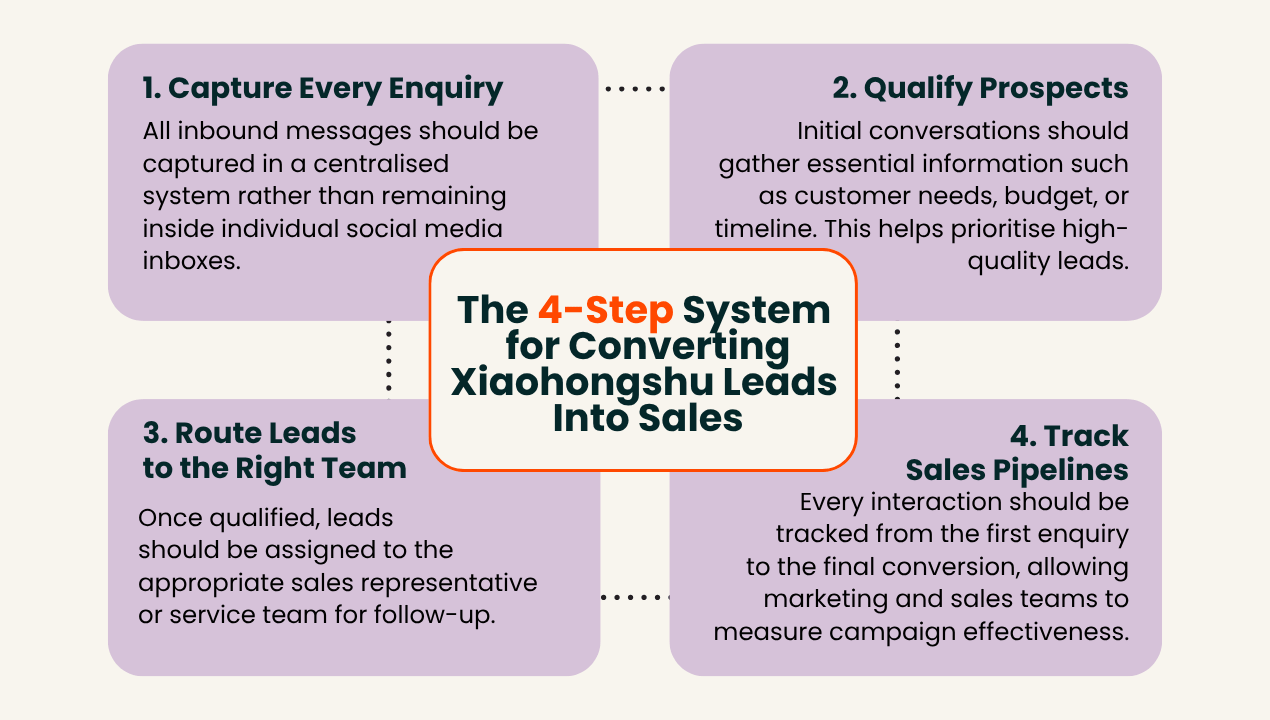
To consistently turn social engagement into revenue, businesses need a structured process. Most successful organisations follow a four-step lead management system.
1. Capture Every Enquiry
All inbound messages should be captured in a centralised system rather than remaining inside individual social media inboxes.
2. Qualify Prospects
Initial conversations should gather essential information such as customer needs, budget, or timeline. This helps prioritise high-quality leads.
3. Route Leads to the Right Team
Once qualified, leads should be assigned to the appropriate sales representative or service team for follow-up.
4. Track the Sales Pipeline
Every interaction should be tracked from the first enquiry to the final conversion, allowing marketing and sales teams to measure campaign effectiveness.
When this process is implemented properly, social media engagement becomes a predictable and scalable lead generation channel.
How MsgBox Helps Businesses Manage Xiaohongshu Leads
AI Agents like MsgBox software are designed to straighten this lead conversion process by connecting social messaging platforms with CRM systems.
MsgBox consolidates multiple communication channels into a single dashboard, allowing businesses to manage conversations across:
- TikTok
- Xiaohongshu and other messaging platforms
This unified approach ensures no enquiry is lost across fragmented accounts, even when staff manage both personal and business messaging profiles.
Real-Time AI Translation
Many companies operate across Chinese and English speaking markets. MsgBox includes real-time AI translation, allowing teams to communicate seamlessly between Chinese and English without language barriers.
CRM Synchronisation
All captured leads can be synchronised with CRM systems such as HubSpot. This allows organisations to track every conversation from initial enquiry through to revenue.
See Visible Results with MsgBox
Companies that centralise social messaging and CRM workflows typically see measurable improvements in sales performance.
Businesses using solutions like MsgBox often achieve:
- 80 percent faster response times to customer enquiries
- Three times more captured leads from social media conversations
- Up to 75 percent higher conversion rates
These improvements occur because conversations are no longer scattered across multiple platforms. Every enquiry becomes part of a structured and trackable sales process.
.png?width=1270&height=720&name=Blog%209%20Graphic%20(2).png)
Best Practices for Converting Xiaohongshu Engagement Into Revenue
To maximise revenue from XHS, Singapore businesses should implement the following practices:
- Capture every inbound DM in a central CRM system
- Respond promptly to maintain engagement momentum
- Use structured qualification to identify high-quality prospects
- Route leads to the appropriate team members for personalised follow-up
- Build a repeatable process so social conversations consistently translate into measurable sales opportunities
By combining CRM integration, automation, and structured workflows, businesses can convert XHS engagement into a reliable source of revenue, turning high-intent social interactions into a predictable sales pipeline.
Turn Xiaohongshu Enquiries Into a Revenue Channel Today
Xiaohongshu generates valuable conversations, but without the right infrastructure those enquiries rarely translate into measurable revenue.
MsgBox helps businesses transform fragmented social media messages into a structured lead pipeline. By centralising messaging channels, automating lead qualification, and synchronising data with CRM systems such as HubSpot, organisations can manage enquiries more efficiently and scale their sales processes.
Book a consultation with NetFarmer today to see how MsgBox can turn your Xiaohongshu enquiries into a scalable source of revenue.
Frequently Asked Questions
What are Xiaohongshu leads?
Xiaohongshu leads are users who enquire about a product or service through direct messages after discovering content on the platform.
Why are Xiaohongshu leads considered high intent?
Users actively search for reviews and recommendations, meaning they are already evaluating purchase decisions.
How do you track Xiaohongshu leads?
Leads can be tracked by integrating direct message conversations into a CRM system where each enquiry is logged and monitored.
Can Xiaohongshu leads be automated?
Yes. Automation tools can handle initial responses, qualification, and routing while still allowing human follow-up for conversions.
.png)