
The lowdown:
People trust AI answers because they compile information faster and feel less biased than traditional websites. AI tools simplify heavy content, organise information, and present answers in a conversational format that feels more human and accessible.
While AI tools may seem all about convenience, this new age of search reflects deeper psychological reasons behind how people judge credibility, authority, and trust online.
Official Websites Are Losing the Trust Battle
A growing number of people now trust answers from AI tools faster than they trust information directly from official company websites. Instead of spending hours surfing the internet to dig up the information they need, users ask ChatGPT, Gemini, or Perplexity for immediate answers and often accept the response without verifying the source.
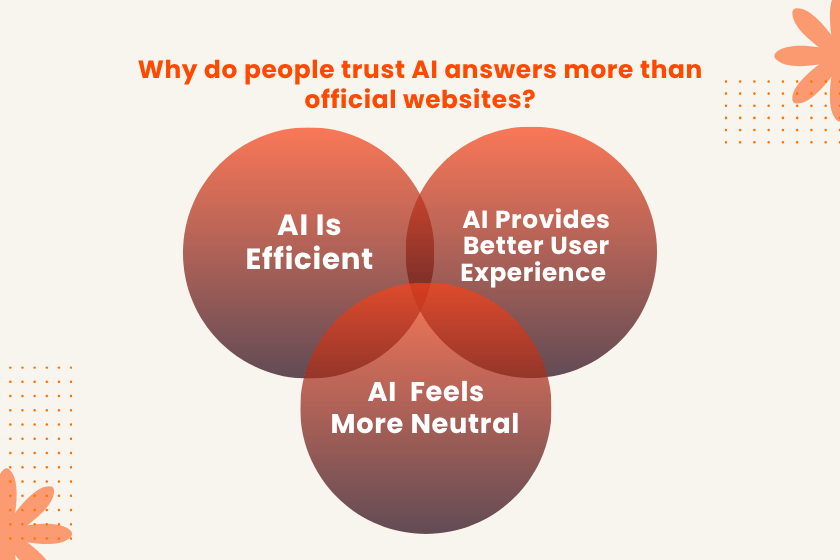
Why do people trust AI answers more than official websites?
Three core reasons explain this:
-
AI is efficient — Users now ask questions directly instead of browsing multiple sources
-
AI provides better user experience — Direct answers arrive instantly without navigation or forms
-
AI feels more neutral — Users perceive AI as synthesising multiple sources rather than selling one product
AI is widely used by consumers to make buying decisions. Particularly in Singapore, 49% of consumers now use AI tools like ChatGPT for shopping (data from Ayden retail report 2025). Millennials lead adoption at 64%, and 67% say AI helps them generate inspiration for outfits or meals faster than anyone else. This shows that consumers are confident in AI suggestions, and that trust in AI is a consensus when looking for new or alternative options.
AI feels trustworthy because it provides fast answers
This taps into cognitive fluency which is the psychological principle that people trust information that is easier to process.
AI tools save people time by providing direct answers instantly.
We enter one question into the LLM of your choice and it gives you all the information you may need right at your fingertips. AI helps to reduce your decision fatigue by summarising complex information into digestible answers.
When information feels smooth and effortless, our brains unconsciously rate it as more truthful and competent.
Trust in AI Feels Easier Because It Provides Better User Experience
People associate ease and speed with confidence and reliability, and AI delivers exceptionally in both areas.
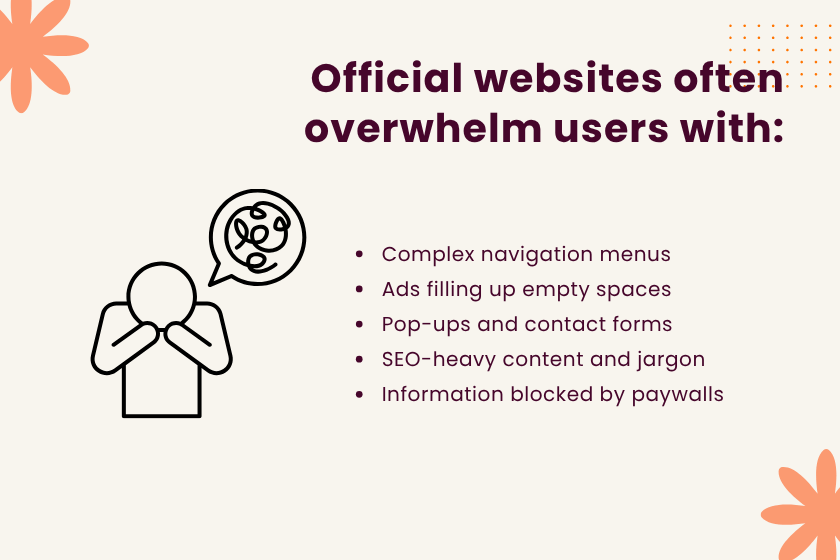
Official websites often overwhelm users with:
- Complex navigation menus
- Ads filling up empty spaces
- Pop-ups and contact forms
- SEO-heavy content and jargon
- Information blocked by paywalls
AI on the other hand, delivers information in a clearer manner, summarising information into a single page without distractors or unnecessary pop ups. Information is also delivered in a bite sized and conversational manner which makes it easier to digest.
People Perceive AI as More Neutral Than Brand Websites
AI feels more neutral because users assume official websites are trying to sell something, while AI appears to aggregate multiple perspectives. Meanwhile, corporate websites are viewed as marketing site first, information sources second. Audiences will naturally feel more on guard when scouring these sites for information as they don't want to get caught in the "trap".
AI is perceived as "objective" due to its ability to aggregate data from various sources. When someone independently vouches for something, we are more likely to believe what they say.
The psychology of third-party validation is powerful here.
That is also why review sites, Reddit, forums, and AI summaries feel more credible because they're perceived as independent. Furthermore, AI answers frequently cite or reference multiple perspectives, and consumers increasingly cross-check companies through AI instead of directly researching through the brand sites.
Search Behaviour Has Changed
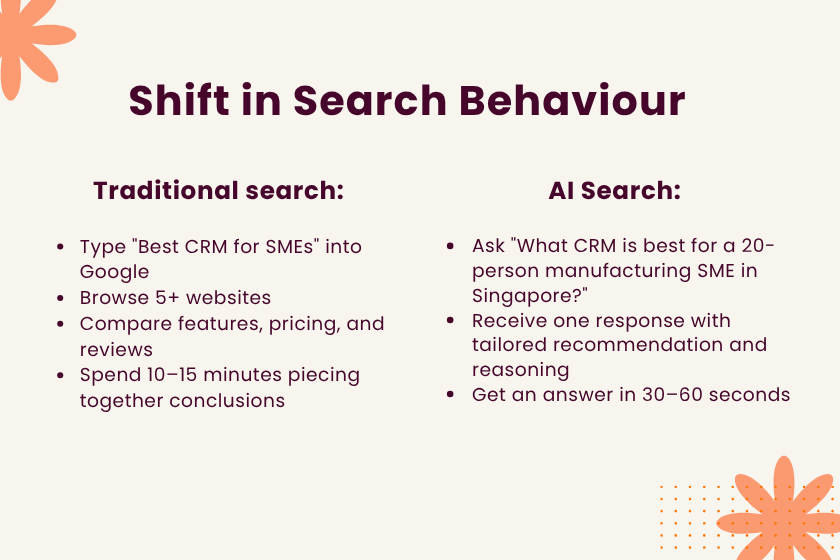
Traditional search required scanning multiple sources and comparing results. AI changes this by letting users ask questions directly and receive one synthesised answer.
Traditional search:
- Type "Best CRM for SMEs" into Google
- Browse 5+ websites
- Compare features, pricing, and reviews
- Spend 10–15 minutes piecing together conclusions
AI Search:
- Ask "What CRM is best for a 20-person manufacturing SME in Singapore?"
- Receive one response with tailored recommendation and reasoning
- Get answer in 30–60 seconds
Why do users prefer asking AI over searching?
Users prefer conversational prompts over keyword searches because they feel more in control and uncertainty is reduced. People trust what resolves ambiguity fastest, not necessarily what is most authoritative.
This reflects zero-click expectations, where users expect immediate resolution without visiting multiple websites. Patience for multi-step research journeys has dropped sharply. AI acts as a shortcut for decision-making, not just information retrieval. That is why AEO (Answer-Engine Optimisation) is emerging as an alternative to SEO.
Why does this make AEO more important than SEO?
This shift is why AEO matters more than traditional SEO. If brands are not structured to answer questions directly, they are excluded from the discovery layer entirely.
SEO targets clicks. AEO targets citations.
|
Aspect |
Traditional SEO |
AEO |
|
Goal |
Rank high on Google |
Be selected as the answer |
|
Input |
Keywords |
Questions |
|
Content |
Long articles |
Short, extractable answers |
|
Success metric |
Traffic |
AI mentions & citations |
|
User behaviour |
Clicks through links |
Gets answer without clicking |
McKinsey projects that by 2028, $750 billion in U.S. revenue will flow through AI-powered search. Half of all consumers now intentionally seek out AI-powered search engines as their primary tool for buying decisions. Yet only 16% of brands track their AI search performance.
What does this mean for AEO?
AEO means writing for extraction, not just persuasion. AI tools extract specific chunks of content, not entire pages.
Your page must be easy to extract, understand, and trust. That means:
- Answer first, explain later
- Structure content into extractable blocks
- Write in question-based format
- Keep answers concise and precise
- Use strong formatting for readability
- Add FAQ-style sections
- Build authority signals on the page
Trust Is No Longer Built the Same Way
AI is reshaping how people evaluate authority online. Trust online is shifting from pages to answers. Clarity, convenience, and contextual relevance matters to the average reader, not just domain authority or backlink counts.
AEO and SEO work hand-in-hand now. Official websites still matter, but their role is changing: they now need to support AI-visible answers, not just host brand messaging. Brands that write clearly, structure content well, and earn authority beyond their own site, will be the ones AI chooses to surface.
.png)
.png)