Most CRM failures are not technology problems. They are behaviour, process, and leadership problems.
Many SMEs invest in CRMs expecting instant pipeline visibility, cleaner forecasting, and faster sales growth. But adoption often drops within months because the underlying sales processes, reporting habits, and leadership behaviours never changed.
Adoption did not fail because the platform was weak. It failed because the operational systems around it were never properly defined. The CRM simply exposes operational gaps that already existed.
This is where many discussions on CRM become misleading. Businesses often focus heavily on setup and automation, but much less on the behavioural and operational structures that sustain adoption long term.In this article, we cover:
- What causes CRM adoption problems in Asian SMEs?
- What operational problems usually undermine CRM adoption?
- What are the hidden costs of poor CRM adoption?
- How can SMEs improve CRM adoption?
- How does HubSpot support CRM adoption for SMEs?
- What is the biggest misconception about CRM implementation?
What causes CRM adoption problems in Asian SMEs?
CRM adoption problems usually happen because the system creates friction before users see value.
Sales teams are expected to update records, log activities, and maintain pipelines, but many do not understand how the CRM helps them close deals faster. The platform becomes administrative work rather than a practical sales tool.
This gets worse when businesses force teams into rigid sales processes that do not reflect how they actually sell.
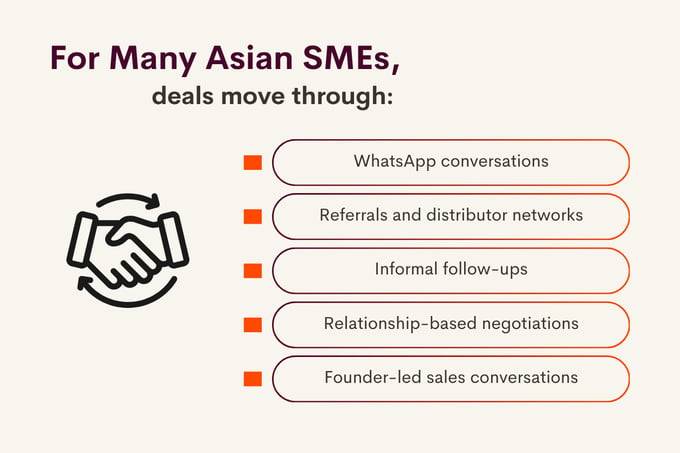
For many Asian SMEs, deals move through:
- WhatsApp conversations
- Referrals and distributor networks
- Informal follow-ups
- Relationship-based negotiations
- Founder-led sales conversations
Trying to force those workflows into overly structured pipelines often creates resistance instead of visibility.
For a more detailed deep dive on what makes adoption different in Asia, check out our related article here.
What operational problems usually undermine CRM adoption?
Poor CRM adoption tends to follow the same operational patterns repeatedly.
Undefined sales stages
Many SMEs never formally define what pipeline stages actually mean.
For example:
- one salesperson marks a deal as “qualified” after a first call
- another only uses it after pricing discussions
- a third updates deals retroactively before review meetings
Leadership sees a healthy-looking pipeline, but the underlying data is inconsistent.
Forecasting becomes unreliable because the organisation lacks shared operational definitions.
Manual admin fatigue
CRM friction increases rapidly when teams are required to complete excessive manual updates.
Reps often lose momentum when:
- too many fields are mandatory
- pipelines become overly detailed
- workflows require repetitive data entry
- activity logging feels disconnected from actual selling
Over time, users start entering the minimum amount of information possible simply to move deals forward.
Poor CRM hygiene is often a workflow design problem rather than a motivation problem.
Leadership bypassing the CRM
One of the fastest ways to damage adoption is when leadership ignores the system themselves.
If managers continue requesting updates through:
- spreadsheets
- ad hoc meetings
- private messages
…the CRM immediately becomes secondary.
Teams follow operational behaviour from leadership more than training documentation.
When executives rely on CRM dashboards consistently, adoption usually improves. When they bypass the platform, the rest of the organisation follows.
Weak cross-functional ownership
CRM adoption rarely belongs to sales alone.
Marketing, customer success, and operations teams all contribute to CRM quality through:
- lead management
- customer updates
- lifecycle tracking
- account ownership
- reporting consistency
When ownership is fragmented, data quality deteriorates quickly because nobody feels accountable for maintaining operational standards.
At NetFarmer, we help regional and international businesses build the systems, processes, and customer journeys needed to scale across Asia.
From our Singapore and Shanghai headquarters, we help businesses scale across Asia through HubSpot-powered CRM, marketing automation, revenue operations, and customer experience transformation.
What are the hidden costs of poor CRM adoption?
Poor CRM adoption creates operational drag long before businesses recognise the financial impact.
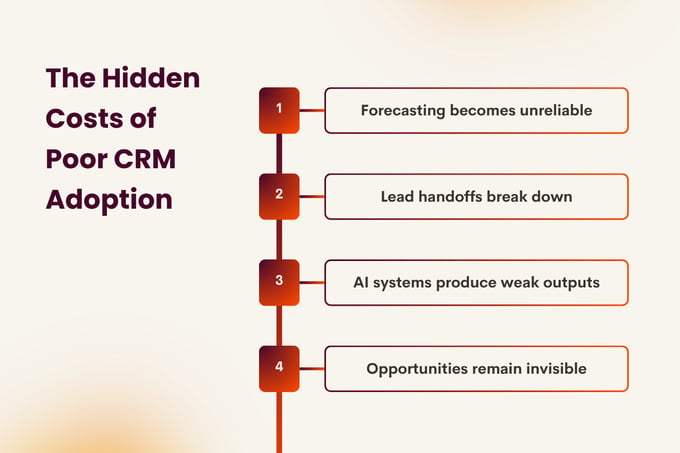
Forecasting becomes unreliable
Incomplete or inconsistent pipeline data makes revenue forecasting unstable.
That affects:
- hiring plans
- budgeting decisions
- inventory planning
- sales targets
- resource allocation
Businesses start making operational decisions based on incomplete visibility.
Lead handoffs break down
Without consistent CRM usage, lead ownership becomes unclear.
Marketing teams may generate leads successfully, but:
- follow-ups become inconsistent
- opportunities get duplicated
- customers receive conflicting outreach
- sales context gets lost during handovers
This creates friction between departments and weakens customer experience simultaneously.
AI systems produce weak outputs
AI tools depend heavily on structured CRM data.
Poor CRM hygiene reduces the effectiveness of:
- lead scoring
- forecasting models
- automation workflows
- enrichment tools
- customer segmentation
Messy operational data creates unreliable AI outputs.
This is becoming increasingly important as SMEs adopt AI-enabled sales workflows without first improving CRM discipline.
Opportunities remain invisible
Expansion opportunities are difficult to identify when customer activity histories are fragmented across:
- inboxes
- spreadsheets
- messaging apps
- personal notes
Customer success teams lose visibility into account development because operational context is incomplete.
How can SMEs improve CRM adoption?
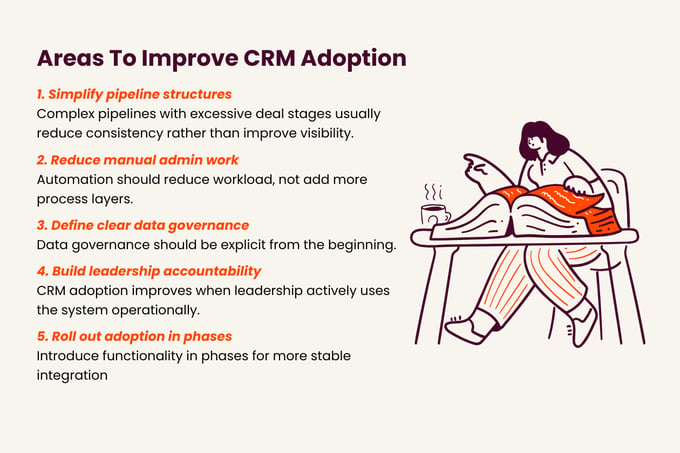
1. Simplify pipeline structures
Many SMEs overbuild their CRM too early.
Complex pipelines with excessive deal stages usually reduce consistency rather than improve visibility.
Start with:
- fewer stages
- clearer definitions
- simpler reporting structures
Operational consistency matters more than process sophistication initially.
2. Reduce manual admin work
Automation should reduce workload, not add more process layers.
Focus first on automating:
- meeting logging
- lead assignment
- follow-up reminders
- contact enrichment
- repetitive internal notifications
The lesser the administrative effort required, the more sustainable adoption becomes.
3. Define clear data governance
Data governance should be explicit from the beginning.
Teams need shared clarity around:
- who owns record updates
- when activities should be logged
- which fields are mandatory
- how pipeline stages are defined
- what reporting standards exist
Without governance, data quality usually declines within months.
4. Build leadership accountability
CRM adoption improves when leadership actively uses the system operationally.
Managers should:
- review dashboards consistently
- run pipeline discussions from CRM data
- avoid requesting offline updates
- reinforce shared reporting structures
Adoption becomes cultural when leadership behaviour reinforces it consistently.
5. Roll out adoption in phases
Many SMEs introduce too much functionality too quickly.
A more sustainable rollout often looks like:
1. pipeline visibility
2. activity tracking
3. lead management
4. reporting consistency
5. automation optimisation
Operational maturity develops gradually, additional features are only considered when necessary for daily work.
How does HubSpot support CRM adoption for SMEs?
HubSpot works well for SMEs because the platform can scale operationally without forcing enterprise-level complexity too early.
Teams can begin with relatively lightweight workflows, then introduce:
- more advanced reporting
- automation layers
- lifecycle segmentation
- RevOps structures
…as operational consistency improves.
That flexibility is important for SMEs still formalising internal processes.
What is the biggest misconception about CRM implementation?
The biggest misconception is that CRM success comes from software installation alone. CRM success is an operational transformation project, not a technology project.
The businesses that succeed with CRM adoption usually align:
- leadership behaviour
- sales workflows
- reporting standards
- operational accountability
- data governance
Technology supports that transition, but it does not create it automatically.
For many Asian SMEs, the real challenge is earning how to operationalise growth without losing the relationship-driven strengths that helped the business scale in the first place. We explore those structural and cultural dynamics further in our article on what HubSpot adoption in Asia reveals about regional sales culture.
Why CRM adoption in Asia requires a different approach
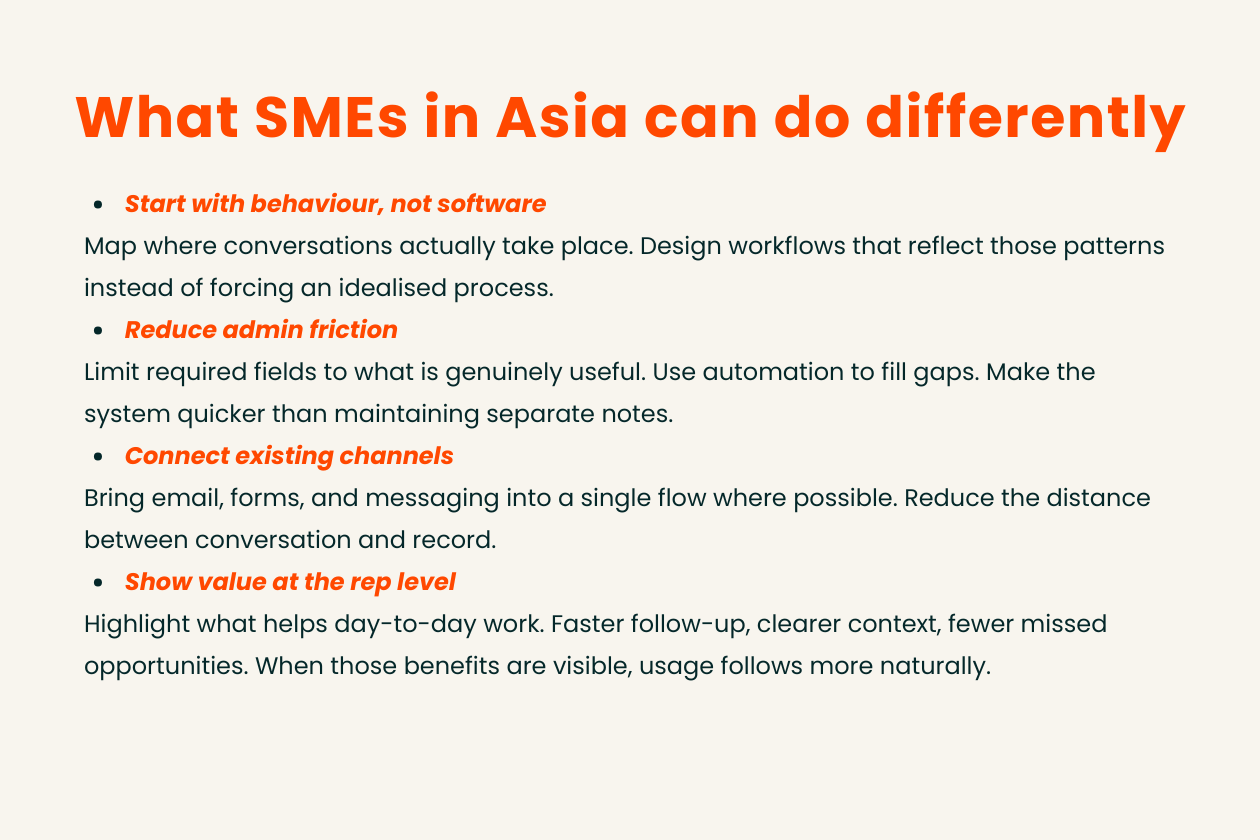
CRM adoption in Asia often fails when businesses copy operational models that were designed for very different sales environments. Across many Asian SMEs, growth still depends heavily on relationships, founder involvement, distributor networks, and informal communication channels.
The companies that succeed with CRM adoption in Asia are usually the ones that adapt the system around how their teams actually work, instead of forcing teams into rigid workflows that look good in theory but fail in practice. They simplify processes, reduce friction, and gradually build operational discipline as the business scales.
That is also why CRM implementation should never be treated as a one-off setup project. It is an ongoing operational shift that touches sales culture, reporting habits, leadership behaviour, and customer experience.

%20(2).png)
.png)