The big picture: AI tools are everywhere now. What’s missing is how teams put them to work.
HubSpot’s 2026 State of Marketing Report has just launched, and it’s packed with signals about how AI is reshaping marketing in the year ahead. We’re here to pull out the key takeaways and make sense of what they mean for your team.
Table of contents
- What is the AI adoption gap in marketing?
- What separates AI users from AI winners?
- Why do most marketing teams struggle with AI?
- How are top marketing teams using AI effectively?
- How do you move from AI experimentation to real marketing results?
- Why is AI making content quality more important?
- What should marketing leaders do next?
What is the AI adoption gap in marketing?
The AI adoption gap is no longer about access to tools. It is about outcomes.
The AI adoption gap is the difference between teams that use AI tools and teams that generate measurable business results from AI-driven workflows.
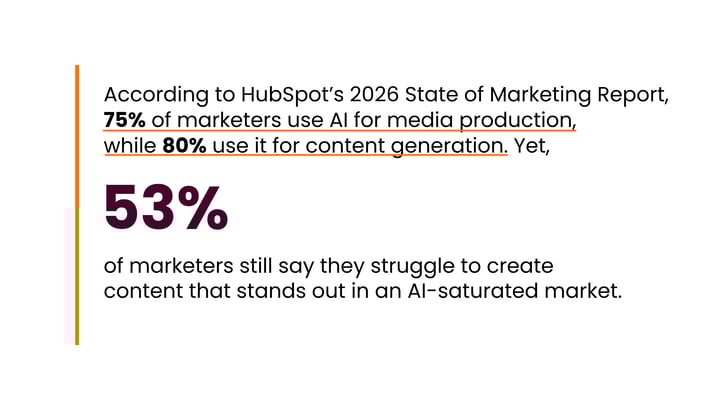
AI is the latest tech that everyone and their aunties are using, becoming the new baseline in marketing. In fact, according to HubSpot’s 2026 State of Marketing Report, 67% of marketing teams say AI saves them 10 or more hours per week, and another 68% say it has meaningfully increased their productivity. Yet even with those numbers, most teams still operate at a low level of marketing maturity, where AI is present but not driving real impact.
AI usage is now common. Effective AI usage is not.
- Most teams use AI for isolated tasks like drafting or brainstorming
- Few teams integrate AI into structured, repeatable workflows
- The real constraint is not access to AI, but the ability to operationalise it
What is scarce amongst teams is the ability to use AI well.
What separates AI users from AI winners?
AI has become integral to the marketing process.
- AI users: Ad hoc usage, task-level gains, inconsistent quality.
- AI winners: System-level integration, KPI alignment, repeatable workflows.
For Example:
An AI user might prompt ChatGPT to “write a promotional email” each time they need one. The output varies in tone, quality, and alignment with the campaign goal.
An AI winner builds a structured workflow, using AI tools to assist in creating tailored messaging to lifecycle stages using CRM data. A human editor then refines tone and ensures brand consistency across all drafts.
The result is not just faster emails, but higher open rates, better conversions, and consistent brand voice across campaigns.
The key difference here lies in AI operationalisation.
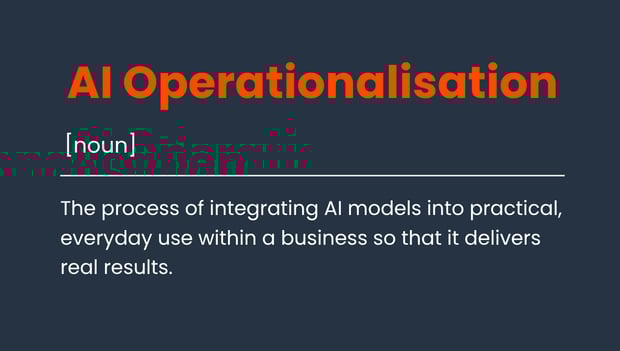
What is AI operationalisation?
AI operationalisation is the process of embedding AI into scalable, reliable workflows that directly impact business KPIs.
With this tension of AI becoming commonplace, a new challenge has emerged: How can your brand stand out and cut through the noise?
The teams seeing real gains have moved past experimentation. They’ve turned AI into an execution layer for their marketing.
Why do most marketing teams struggle with AI?
AI does not fix weak systems. It exposes and scales them. If your messaging is unclear, AI will produce more unclear content, just faster and at scale.
Many teams assume that more AI usage leads to better results. In reality, poor implementation produces poor outcomes faster.
Common pitfalls include:
- Over-automation: automating everything without oversight, leading to shallow and misaligned content
- Generic content: AI produces “average” work without strong direction
- Lack of brand governance: tone drifts without a clear brand voice or internal review process
- Workflow automation without quality control: speed without catering to business goals
- Tool fragmentation: adopt multiple AI tools without a unified workflow
How are top marketing teams using AI effectively?
They use AI to improve content velocity, marketing efficiency, and personalisation at scale, all at the same time. High‑performing teams do not treat these as separate use cases. They integrate them into a single AI‑enabled workflow.
- Speed: AI boosts content velocity and reporting speed, but with *human‑in‑the‑loop editing
- Insight: AI connected to CRM data such as HubSpot delivers scalable insights and customer intelligence
- Personalisation: AI enables personalisation at scale based on lifecycle stage, behaviour, and segmentation
*What is Human-in-the-loop?
Human-in-the-loop (HITL) is an AI approach where humans actively participate in training, tuning, and testing algorithms to ensure accuracy, safety, and ethical decision-making.
AI-smart marketing teams integrate it with daily workflows, boosting output and gathering more data on their target audience. This gives them better visibility on their data insights, thereby turning AI into a competitive advantage.
→ Get to know how NetFarmer uses AI powered tools in Hubspot to help your business grow.
How do you move from AI experimentation to real marketing results?
By building AI‑enabled workflows in the right sequence and treating AI as infrastructure, not a novelty.
For teams looking to move from AI experimentation to measurable impact, the path forward is progressive.
The AI Maturity Ladder for Marketing Teams
1. Start with workflow automation
Automate structured processes such as email sequences, lead routing, and reporting. Focus on consistency and operational discipline.
2. Content acceleration
Use AI to increase content velocity and repurpose existing assets. Maintain quality through human editing and brand governance.
3. Add insight generation
Apply AI to analyse campaign performance and customer behaviour. Turn data into actionable decisions
4. Scale personalisation
Deliver dynamic, segmented content based on lifecycle stage, intent, and behaviour.
Teams that climb this ladder move from experimentation to measurable business impact. Learn more about how to apply these insights into HubSpot’s Loop marketing framework
Why is AI making content quality more important?
Because AI has removed the barrier to producing content. This raises the bar for quality.
When everyone can generate content quickly, differentiation comes from what you choose to publish and how well it’s refined.
- AI makes content production cheap and fast
- Generic content becomes more common, and easier to identify and tune out
- Quality, relevance, and distinctiveness become competitive advantages
What is AI Slop?
When care and human distinction are missing from AI-assisted marketing materials, it may feel repetitive, generic or even insincere to audiences. This type of content is usually referred to as “AI Slop” and can be harmful towards your brand.
Audiences are exposed to the same visual styles and phrasing across their feeds and the web, which leads to visual fatigue. As a result, they start tuning out content they find boring or insincere, especially when it feels obviously created with AI.
AI can generate 10 blog posts. Human judgment decides which one is worth publishing and which nine should be discarded.
The New Advantage Is Human Judgment
The best teams are not focused on volume. Instead, they focus on how useful, clear, and aligned with business goals each marketing piece is.
This mindset shows up in subtle but consistent ways:
- Tighter messaging instead of longer content: they cut fluff and remove filler, so every sentence serves a purpose.
- More opinionated takes instead of neutral summaries: they lean into a distinct point of view rather than vague, safe language.
- Cleaner workflows instead of more tools: they simplify processes and reduce complexity rather than adding another AI layer on top of everything else.
AI can generate 10 blog post drafts from the same keyword. Human judgment decides which one has a strong angle, which ones are redundant, and which should not be published at all.
Strong teams use AI as a first draft engine, then apply judgment to:
-
Select the right ideas
-
Shape tone and voice
-
Cut and refine content
-
Hold outputs accountable to real outcomes
When humans stay in the driver’s seat, AI becomes a tool to amplify taste, not erase it.
What should marketing leaders do next?
Focus on workflow automation, standards, and output quality, not just AI adoption.
If you’re leading a marketing team right now, the question isn’t whether you’ve adopted AI. The next step is defining what “good” looks like and how it is maintained at scale.
- Define where AI fits in your workflows
- Set clear quality standards for outputs
- Build review and refinement processes
- Align AI usage with business goals and KPIs
Because in a world where everyone has AI, the winners won’t be the ones who adopted it first. They’ll be the ones who developed taste, systems, and discipline around it.
If you’re ready to move beyond experimentation and actually operationalise AI in your marketing stack, consider how a HubSpot Solutions Partner can help.
At NetFarmer, we help marketing teams turn AI into a real competitive advantage—by aligning HubSpot workflows, AI‑enabled content systems, and CRM‑driven insight into one clear, repeatable engine.
If you want to:
- Build AI‑enabled workflows that actually scale revenue, not just content volume
- Strengthen brand governance and content quality across channels
- Turn HubSpot into a true execution layer for AI‑driven marketing
We’d be happy to talk through how you can close the AI adoption gap on your own terms.
👉 Book a consultation with NetFarmer today
.png)