In a Nutshell…
Many Singapore SMEs are investing heavily in SEO and still ranking well on Google. Yet when prospects ask ChatGPT, Gemini, Perplexity, or Google's AI Overviews for recommendations, explanations, or vendor suggestions, those same businesses often fail to appear.
The reason is simple: ranking on Google and being cited by AI systems are related, but they are not the same thing.
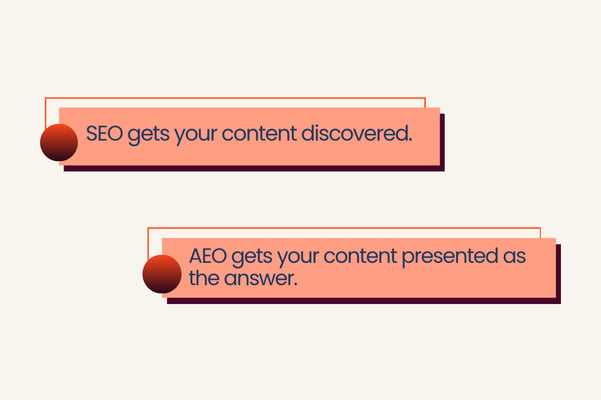
Traditional SEO focuses on helping pages rank in search results. Answer Engine Optimisation (AEO) focuses on helping content become part of the answer itself. As search behaviour evolves, businesses will need to optimise for both.
The Visibility Gap Most SMEs Don't Realise Exists
Imagine your company ranks on the first page of Google for an important keyword.
Historically, that was enough. A potential customer would:
- Search on Google
- Review several results
- Visit your website
- Compare options
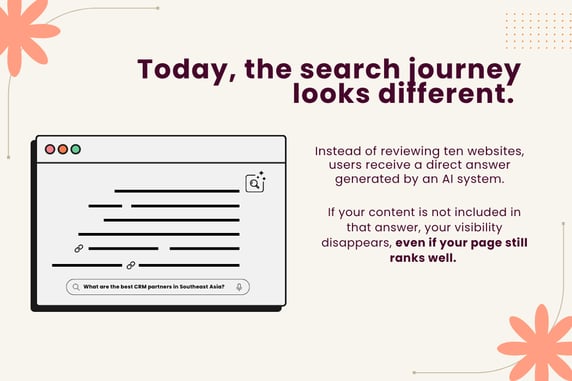
Today, the search journey often looks different. A buyer might ask ChatGPT, Gemini,or other AI search tools:
- "What CRM should a Singapore SME use?"
- "How much does HubSpot implementation cost in Singapore?"
- "What are the best CRM partners in Southeast Asia?"
Instead of reviewing ten websites, they receive a direct answer generated by an AI system.
If your content is not included in that answer, your visibility disappears, even if your page still ranks well. This is what many businesses are experiencing today.
Why AI Search Is Changing Customer Discovery
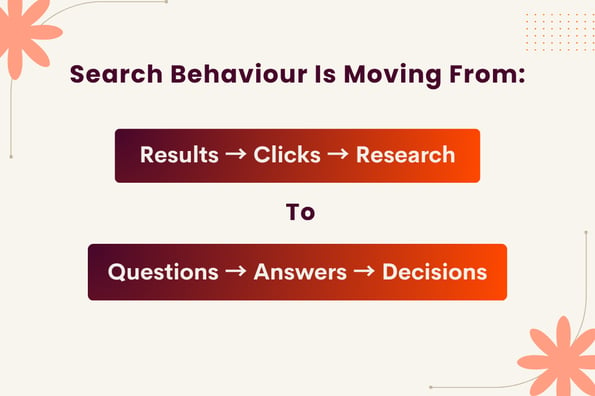
Search behavior is moving from:
Results → Clicks → Research
To
Questions → Answers → Decisions
Users increasingly expect immediate answers. They want:
- recommendations
- explanations
- comparisons
- summaries
- implementation guidance
...without spending extra time reading multiple articles.
This shift changes what content succeeds. The question is no longer: "Can this page rank?"
It is also: "Can this page help contribute to generating the answer?"
What is SEO?
SEO is the practice of improving a page’s visibility in search engines. In practical terms, that means making the content relevant, technically accessible, and credible enough to rank.
What matters in SEO:
- Keywords
- Page structure
- Internal linking
- Metadata
- Load speed
- Quality of content
- And many more…
A page that ranks well usually does more than mention the right phrase. It answers the search intent properly.
That is why SEO content tends to be broader. It is built to cover a topic in depth, earn rankings across related queries, and bring users into the site.
What is AEO?
AEO, or answer engine optimisation, is about making content easy to extract and reuse as a direct answer. The emphasis shifts from broad visibility to answerability. Instead of asking, “Can this page rank?”, you also ask, “Can this paragraph be quoted cleanly and used as a citation by a search engine or AI search tools?”
What matters in AEO:
- Concise answers
- Clear headings
- Structured formats eg. FAQ, bullet points, tables, schema markup
- Answer first format
AEO rewards pages that are easy to parse. They come into play because they reduce ambiguity and help machines identify the most relevant part of the page. If a reader asks a straightforward question, your content should answer it quickly, then support that answer with detail. This is a different writing rhythm from traditional SEO, which often builds up to the answer more gradually.
SEO vs AEO: the main differences
SEO and AEO aim for different kinds of visibility. SEO is about ranking a page. AEO is about surfacing a response.
SEO usually prioritises broader topic coverage, while AEO prioritises directness and clarity. SEO content often supports deeper browsing. AEO content often supports instant understanding.
|
Aspect |
SEO |
AEO |
|
Main goal |
Rank in search results and earn clicks |
Be selected as the direct answer |
|
User behaviour |
People browse results in SERPs and choose a link |
People expect an instant answer to their detailed question |
|
Content approach |
Long-form, keyword-aware, comprehensive |
Concise, structured, question-led |
|
Technical focus |
Crawlability, indexing, backlinks, site health |
Clarity, schema, factual consistency, extractability |
|
Success metric |
Rankings, traffic, conversions |
Snippets, citations, voice responses, AI inclusion |
How SEO and AEO work together
The strongest pages are built for both.
SEO helps you win the page, while AEO helps you win the answer. SEO is measured through rankings, traffic, and conversions. AEO is measured through snippet placement, answer citations, voice results, and visibility inside AI-driven search experiences.
The official Google Search Central policies supports this in their guide on "Optimising for generative AI features on Google Search" page.
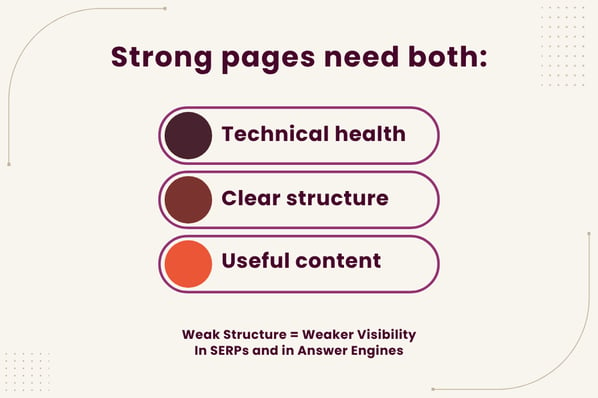
However, that does not mean AEO will replace SEO. It sits on top of it. If your site is weak technically, unclear in structure, or thin on useful information, it will struggle in both worlds. AEO only works properly when the underlying SEO fundamentals are already in place.
A page can rank well and still fail to appear in answer-driven results if it is poorly structured. It can also be concise enough for AEO and still miss the broader search signals that SEO needs.
Why This Matters for Singapore SMEs
This trend is particularly important for SMEs because visibility has always been one of the biggest competitive advantages smaller businesses can achieve.
Traditionally, a smaller company could compete with larger brands through strong SEO.
Today, AI systems increasingly favour sources that demonstrate:
- expertise
- authority
- trustworthiness
- topical depth
This creates both a challenge and an opportunity.
SMEs that adapt early can become highly visible within AI-generated answers, even when competing against larger organisations.
How to optimise for SEO and AEO
The best approach is not to split your strategy in two. It is to build content that serves both search engines and answer engines from the start.
That begins with a simple discipline: answer the main question early, then expand.
- Put the main point near the top so readers and answer engines can find it quickly.
- Write for clarity, not for length.
- Use a clear structure with headings and hierarchy.
- End with related questions in an FAQ that reflects what readers are likely to ask next.
- Refresh older content and review internal links between new and existing pages.
Common mistakes Businesses Make when doing AEO
-
Hiding the answer too far down the page so readers and answer engines struggle to find it quickly.
-
Writing for algorithms instead of for people by using overcomplicated language.
-
Writing in a bloated, keyword-heavy style that makes the content harder to read and less likely to be reused as an answer.
- Using poor formatting such as dense paragraphs, weak headings, and vague subheads that make the content harder to scan, index, and quote.
The Future of Search Is Not SEO or AEO
Both comes into play, AEO is not replacing SEO. Strong SEO remains essential because AI systems still rely heavily on discoverable, trustworthy web content.
Search is becoming more answer-led. More users are getting what they need from snippets, AI summaries, and direct responses rather than traditional result pages. That means content has to do more than rank. It has to be clear enough to quote, useful enough to trust, and structured enough to reuse.
The best approach is simple: write for people, structure for machines, and make the answer obvious.
For marketers, that is a useful pressure. It pushes content away from vague generalities and towards sharper, more useful writing. It rewards pages that say something concrete, in language that a person can use and a machine can recognise.
The companies that succeed over the next few years will be the ones that understand this shift early.
The goal is no longer just to win the search result. The goal is to become part of the answer.