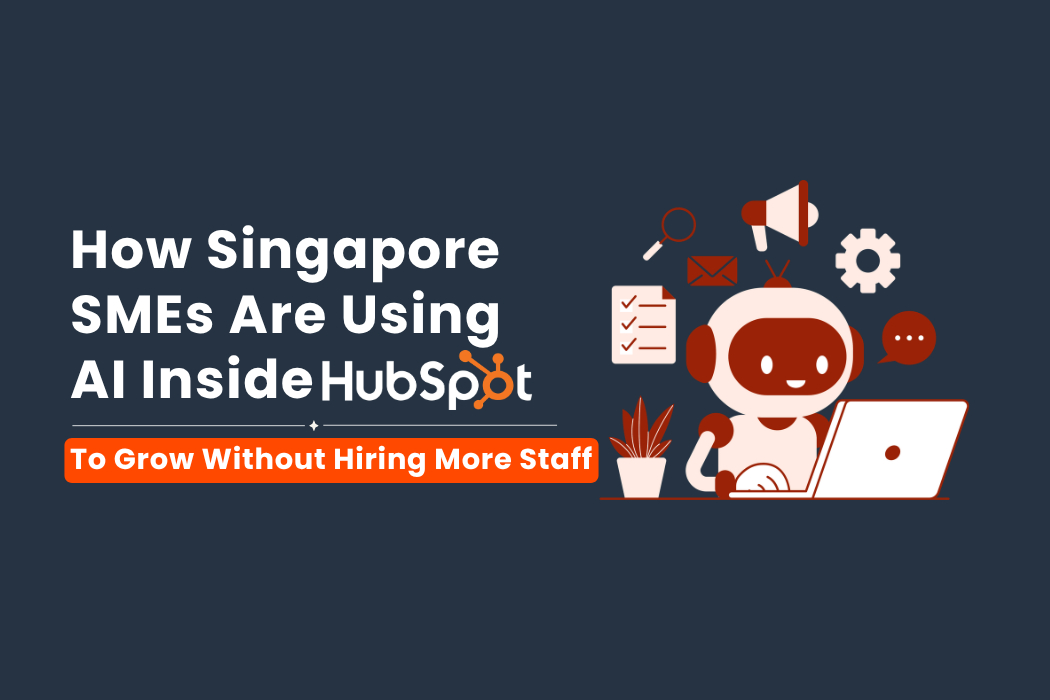
Singapore SMEs are not adopting AI for novelty. They are doing it because labour is tight, expectations are high, and margins leave little room for inefficiency. Furthermore, there are programmes like the Productivity Solutions Grant which actively encourage adoption of CRM and AI tools, accelerating this trend.
The interesting shift is not just “using AI”, but embedding it inside systems they already rely on, especially HubSpot CRM, to quietly remove repetitive work and sharpen decision making.
Why does AI inside HubSpot matter for SMEs?
The short answer is that it turns a CRM from a passive database into an active assistant that nudges teams towards better actions.
Most SMEs I have worked with in Singapore already use HubSpot for pipeline tracking or marketing automation. What changes with AI is not the interface, but the workload behind it. Tasks that used to sit in someone’s head or on a messy spreadsheet now happen automatically, often in the background.
For example, a small B2B distributor in Jurong that I advised last year used to have one sales coordinator manually qualify inbound leads. With HubSpot’s AI scoring and enrichment, they cut that role down to half-time work. The system now flags high intent leads based on behaviour and firmographic data, and routes them directly to sales. Response time dropped from about 18 hours to under 2 hours, which directly lifted conversion.
How are SMEs using HubSpot AI in practice?
Based on our work with local businesses, we do not recommend them to use every feature. The most effective teams focus on a handful of features that target their pain points, which compound over time to improve efficiency in the long run .
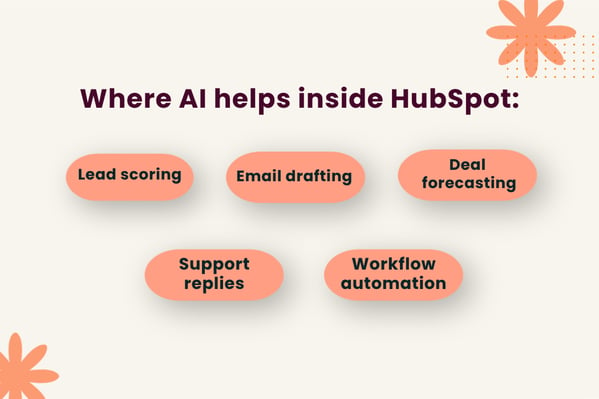
1. Automating lead qualification and routing
AI analyses form submissions, email engagement, and website behaviour to score leads automatically. This removes the need for manual triage.
- Leads are enriched with company size, industry, and likely budget.
- High scoring leads are assigned instantly to sales reps.
- Low scoring leads are nurtured with automated sequences.
This mirrors findings from HubSpot’s own AI adoption report, which notes that automated lead scoring can improve sales productivity by reducing time spent on unqualified prospects HubSpot, 2024.
2. Writing and optimising outreach at scale
AI tools inside HubSpot generate email drafts, subject lines, and follow ups based on deal context.
One SaaS founder in Singapore told me he now reviews rather than writes first drafts. It sounds trivial, but it cuts cognitive load. Instead of staring at a blank screen, sales reps start with something workable and refine it.
- Email sequences are personalised using CRM data.
- AI suggests timing and frequency based on engagement patterns.
- A/B testing becomes faster because variations are generated quickly.
3. Predicting deal outcomes and prioritising pipeline
AI analyses historical deals to predict which current opportunities are likely to close.
- Sales teams focus on deals with higher probability.
- Managers get early warning signals on stalled pipelines.
- Forecasting becomes less dependent on gut feel.
According to McKinsey, companies using AI driven sales analytics see up to 50 percent improvement in lead conversion rates in some cases
4. Automating customer support responses
HubSpot’s AI can draft replies to common support queries or power chatbots that handle first line interactions.
For SMEs with lean teams, this is often the quickest win.
- FAQs are answered instantly via chat.
- Support agents handle only complex cases.
- Response times drop without hiring more staff.
Singapore’s Infocomm Media Development Authority highlights AI driven automation as a key lever for SME productivity gains, particularly in customer service workflows IMDA, 2024.
What operational outcomes are SMEs actually seeing?
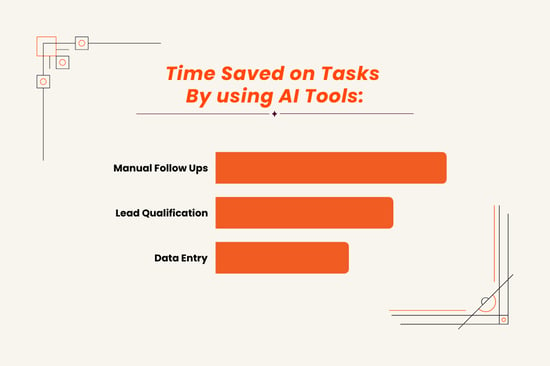
The benefits are not abstract. They show up in very specific operational metrics.
- Shorter sales cycles because follow ups happen on time.
- Higher lead to customer conversion due to better prioritisation.
- Reduced admin workload for sales and marketing teams.
- More consistent customer experience across touch points.
One pattern I keep seeing is that AI does not replace roles, but compresses them. A three person sales team starts behaving like a five person team, not because they work harder, but because less time is wasted on low value tasks.
Why using HubSpot AI is a good fit for Singapore SMEs
Singapore has a unique mix of constraints and advantages that make this approach effective.
- Labour costs are high, so automation has a clear ROI.
- SMEs are typically small enough to implement changes quickly.
- Government support for digitalisation lowers adoption barriers.
Use this AI Implementation Framework to get started:
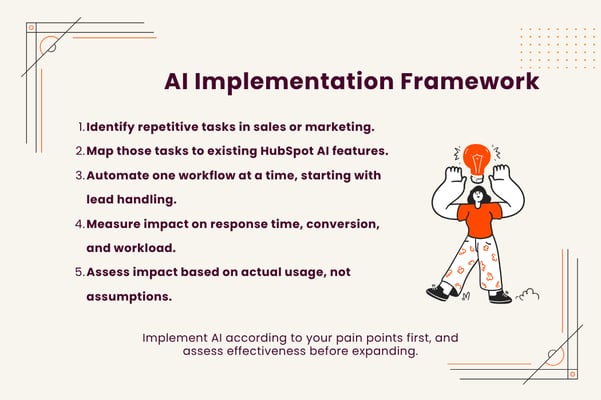
If you are running an SME and already using HubSpot, the goal is not to “implement AI everywhere”.
Use AI effectively to target friction points already existing in your business.
- Identify repetitive tasks in sales or marketing.
- Map those tasks to existing HubSpot AI features.
- Automate one workflow at a time, starting with lead handling.
- Measure impact on response time, conversion, and workload.
- Assess impact based on actual usage, not assumptions.
The teams that succeed are the ones that treat AI as a way to improve operational efficiency, not an industry buzzword.