What Is the Best CRM for SMEs in Singapore in 2026?
This guide provides a clear, side by side comparison tailored specifically for SMEs in Singapore, focusing on usability, pricing considerations, scalability, and real world suitability. Whether you are upgrading from spreadsheets or replacing an underperforming system, the goal is to help you identify which CRM fits your day-to-day operations.
Table of Contents
1. Overview: How To Choose the Right CRM2. Quick Snapshot: Strengths and Best Fit of Each CRM
3. CRM Comparison: Usability, Features, and Integrations
4. Prioritise what matters to you
5. Summary
-2.png?width=535&height=303&name=Blogpost%203-1%20(Table)-2.png)
Choosing the best CRM for SMEs in Singapore is no longer about features alone. It is about finding a system that fits your sales complexity, reporting needs, automation maturity, and growth plans.
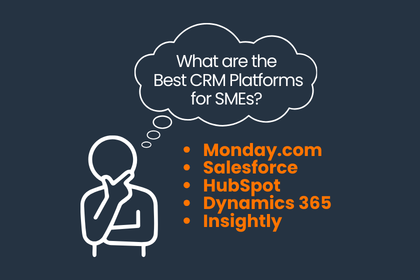
With platforms such as monday.com, Salesforce, HubSpot, Microsoft Dynamics 365, Insightly and Zoho CRM all targeting growing businesses, the real question is not which CRM is the most powerful, but which one is right for your stage of growth.
In this article, we will be comparing the following list of popular CRMs available on the market to pick out what is the best CRM for your business:
1. How to Choose the Right CRM for Your SME in Singapore
Choosing between platforms such as HubSpot, Salesforce, Microsoft Dynamics 365, Zoho CRM, monday.com and Insightly ultimately depends on how complex your sales process, team structure, and automation requirements are. Feature comparisons are useful, but they only matter once you understand your own operational reality. If you have not yet defined your sales model, team size, budget constraints, and integration needs, revisit our earlier post on How to choose the right CRM for your SME in Singapore. That framework will help you evaluate each platform with clarity rather than being influenced by feature lists alone.
2. CRM Capability Breakdown by Platform
Monday.com CRM
What it is: A visual work management platform with CRM capabilities on top.
Best for: Teams with straightforward sales pipelines and want a lightweight and adaptable CRM.
Key strengths:
Highly visual and intuitive for non‑technical users
Flexible workflows that are closer to project management than rigid CRM structures
Ideal for agencies, operations teams, and project‑intensive services
Limitations:
CRM features are improving but pales in comparison with CRMs with dedicated platforms for advanced sales, service, or marketing automation
Salesforce
What it is: One of the most powerful, enterprise level CRMs on the market.
Best for: Larger or complex organisations that require extensive customisation and have a budget for implementation and a dedicated CRM administration.
Key strengths:
- Extremely flexible and customisable for complex sales processes
- Massive external App support in their AppExchange marketplace and partner ecosystem
- Strong support for organisations that operate across multiple teams, regions, and products
Often requires specialist admins or partners
Might be overly complex (and expensive) for smaller SMB teams
HubSpot CRM
What it is: A comprehensive platform that brings together marketing, sales, service, and content tools around a unified CRM.
Best for: Growing SMBs and mid‑market teams that want strong marketing + sales + service alignment with emphasis on ease of use.
Key strengths:
-
Very user‑friendly interface; fast to onboard for non‑technical teams
-
Advanced native tools for marketing, content, SEO, email, automation, and customer service
-
Strong fit if you want one platform rather than spreading software budget across 5 to 6 office tools
Limitations:
Costs can ramp up at higher tiers, especially with larger contact volumes, but this often substitutes expenses for different work tools
Microsoft Dynamics 365
What it is: A collection of business applications (CRM + ERP) tightly integrated with the broader Microsoft ecosystem.
Best for: Microsoft‑centric mid‑market and enterprise organizations that live in Office 365, Teams, and Azure.
Key strengths:
- Deep integration with Outlook, Teams, and other Microsoft apps
- Strong for organisations needing CRM + ERP or advanced operational workflows
- Highly configurable for complex, regulated, or multi‑business‑unit environments
Typically requires IT involvement and specialist expertise
Not the fastest starting point for lean marketing or content‑led teams
Insightly
What it is: A CRM with a strong project and delivery focus, aimed at services‑oriented businesses.
Best for: Services firms, agencies, and consultancies that need CRM + project management without an enterprise‑level footprint.
Key strengths:
- Good blend of sales pipeline + project tracking
- Solid fit for teams that want post‑sale delivery workflows inside the same system
- Generally more budget‑friendly than heavyweight CRMs
Limitations:
Marketing and automation capabilities are lighter than platforms like HubSpot, Salesforce, or Dynamics
Zoho CRM
What it is: A feature‑rich CRM as part of a broader Zoho suite of business apps.Best for: Cost‑conscious small businesses that want a lot of capability and are comfortable configuring their own stack.
Key strengths:
- Very affordable entry pricing
- Wide feature set and good automation for the price
- Integrates naturally with other Zoho apps (email, finance, support, etc.)
Interface can feel less polished than some competitors
Depth of configuration can be a double‑edged sword for non‑technical teams
3. Comparing CRM Functionality, Automation and Integrations
Now that we understand what each CRM offers individually, let’s look at how they stack up against one another.
Key Takeaways: Best CRM by Use and Business Complexity
Best for highly customised enterprise-level B2B sales processes: Salesforce
Salesforce excels in complex approval flows, territory routing, multi-layer forecasting, and deep custom object structures. It is better suited to organisations with structured sales governance and internal CRM ownership.
Best for Microsoft-centric organisations: Microsoft Dynamics 365
Dynamics 365 integrates tightly with Microsoft 365, Outlook, Teams, and Power BI. SMEs already operating within the Microsoft ecosystem typically experience stronger reporting continuity and lower integration friction.
Best “all‑in‑one” CRM for SMEs in Singapore: HubSpot
HubSpot is strongest in marketing automation, lifecycle visibility, and alignment between marketing, sales, and service. SMEs in Singapore looking for a unified platform that leans towards marketing will benefit from its toolset and full-funnel reporting.
Best value automation suite for smaller budgets: Zoho CRM
Zoho offers advanced workflow automation, lead scoring, and reporting at a competitive price tier. It is suitable for cost-conscious SMEs that still require structured automation and cross-functional capability.
Best for fast adoption and visual workflow management: monday.com
monday.com prioritises usability and visual pipeline tracking. It works well for SMEs transitioning from spreadsheets or project management tools into a basic-level CRM structure.
Best for project-driven or service-heavy teams: Insightly
Insightly combines CRM with project tracking, making it practical for consultancies and service firms that need post-sale project visibility alongside deal management.
3.1 Ease of Use and Onboarding
For non-technical teams, adoption speed matters more than raw feature depth.
Easiest to adopt:
HubSpot and monday.com consistently rank highest in usability. HubSpot’s interface is clean, guided, and logically structured around lifecycle stages. Monday.com benefits from its visual boards, which feel familiar to teams already using project management tools.
Zoho and Insightly are relatively intuitive but may require more initial configuration to align fields and pipelines properly.
More complex platforms:
Salesforce and Microsoft Dynamics 365 are powerful but demand structured setup. Field architecture, automation logic, and permission structures require planning. Without proper implementation, these platforms can become cluttered or under-utilised.
From experience, businesses without internal CRM ownership often struggle with Salesforce or Dynamics in the first year. Conversely, companies that invest in a clear data model and admin governance extract significant long-term value.
If your team lacks the experience or technical support, ease of use should be your primary decision maker.
3.2 Core CRM Features and Automation
All six platforms support:
- Contact management
- Deal or opportunity tracking
- Pipeline visualisation
- Basic reporting
The real differentiation appears in automation depth and cross-functional capabilities.
Strong automation ecosystems:
Salesforce, HubSpot, Dynamics 365, and Zoho offer advanced workflow automation, including conditional logic, lead scoring, lifecycle triggers, and reporting customisation.
HubSpot stands out for marketing automation and lifecycle visibility across marketing, sales, and service teams. Salesforce excels in highly customised sales processes and complex approval structures. Dynamics integrates deeply with enterprise resource planning. Zoho offers impressive automation for its price tier.
Lighter automation frameworks:
monday.com and Insightly handle core workflow automation but are less suited to highly complex multi-stage nurturing or enterprise forecasting.
When evaluating CRM automation, consider not only current workflows but future complexity. For example:
- Will you require region-based routing?
- Multi-brand segmentation?
- Advanced revenue forecasting?
Service and support capabilities also vary. HubSpot, Salesforce, and Dynamics provide structured ticketing systems. Zoho includes helpdesk integrations within its suite. Monday.com and Insightly offer lighter service tracking.
If customer service visibility is strategic for your business, ensure the CRM’s service module is mature enough for your needs.
3.3 Ecosystem and Integrations
Modern CRM software does not operate in isolation. It must integrate well with existing office tools like email, calendars, e-commerce platforms, finance tools, and marketing systems.
Largest ecosystems:
Salesforce leads with a vast third-party marketplace. HubSpot has a strong app marketplace with native marketing integrations. Microsoft Dynamics 365 integrates deeply within the Microsoft environment, particularly Outlook, Teams, and Power BI.
Zoho benefits from its broader suite, which reduces reliance on external integrations for smaller businesses.
Best Integrations:
Monday.com integrates well with productivity tools but is not as extensive in industry-specific CRM extensions. Insightly offers common integrations but with a smaller ecosystem footprint.
Tip: Work with your existing tools
When choosing a CRM, consider ease of integration with platforms and softwares that you frequently use first. Integration gaps often create hidden operational inefficiencies later.
For e-commerce or subscription businesses, integration with payment gateways and marketing platforms is often a deciding factor. For B2B enterprises, ERP and finance integration may matter more.
4. Prioritise What Matters, Not What Shines
If you are feeling overwhelmed by all the fancy features at this point, that reaction is entirely normal. Researching and navigating the ins and outs of the variety of CRM platforms available on the market means navigating pages selling impressive functions and promises of increasing productivity. It is easy to walk away with a long list of fancy features that feel essential to the business at the moment.
But let’s take a step back. What do YOU really need?
Steve Jobs once said “Innovation is saying no to a thousand things”.
The same discipline can be applied to picking a CRM for their features. For SMEs, excess capability often creates operational drag. Review your list and consider what features are redundant for your business. What looks strategic during vendor demos can become underused infrastructure six months after going live.
5. Summary
In summary, there is no universal “best CRM”. There is only the right CRM for your stage, structure, and ambition.
- If simplicity and fast adoption matter most to you, Monday.com and Insightly is your pal.
- If cost control is key but you still want strong functionality, Zoho CRM is compelling.
- If you prefer a CRM that starts off simple but has the flexibility to add on different tools or systems as you grow, HubSpot is a great choice.
- If your organisation requires advanced automation, forecasting, and extensibility, Salesforce or Dynamics 365 provides the architecture to support it.
Ensure Your Team Adopts HubSpot from Day One
Implementing HubSpot is only the first step. Real results will only blossom when your team actually uses it. NetFarmer is a certified HubSpot Platinum Partner in Singapore, we help SMEs structure, onboard, and train their teams so HubSpot becomes a central tool for revenue growth.
Our experts guide you to:
- Configure HubSpot to fit your unique sales and marketing workflows
- Onboard your team efficiently for high adoption and consistent usage
- Automate key processes to save time, improve pipeline visibility, and boost revenue
%20blog%20(420%20x%20280%20%E5%83%8F%E7%B4%A0)%20(4).png)