
Many CRM problems do not appear immediately. They surface months later as reporting inconsistencies, duplicated data, stalled deals, or misaligned lifecycle definitions.
That’s exactly what HubSpot onboarding services are meant to prevent.
In this article, we’ll cover:
- What does HubSpot onboarding services include?
- How Long Does HubSpot Onboarding Take?
- HubSpot Onboarding Cost in Singapore
- Is having an onboarding service worth it?
- HubSpot‑led vs partner‑led onboarding
- How to choose the right provider for your business
What does HubSpot Onboarding Include?
HubSpot onboarding services are structured sessions that teach teams how to configure HubSpot to reflect your business processes, data structure and reporting requirements.
Depending on your hubs and subscription tier, onboarding typically includes:
|
1. CRM Architecture
|
2. Process Design
|
|
3. Automation Setup
|
4. Reporting Foundations
|
|
5. Training
|
|
Scope varies significantly depending on whether you are implementing Marketing Hub, Sales Hub, Service Hub, HubSpot CRM, or multiple hubs together.
Hubspot Plans Overview table:
-1.png?width=703&height=399&name=Blogpost%203-1%20(Table)-1.png)
How Long Does HubSpot Onboarding Take?
Most structured onboarding projects take 60 to 90 days. However, the finalised timeline may differ depending on complexity of your business.
Typical timelines:
- Simple setups: 4 to 6 weeks
- Standard onboarding: 6 to 10 weeks
- Complex cross team/region implementations: 8 to 12+ weeks
What affects timeline:
- Decision-making speed
- Number of stakeholders
- Data cleanliness
- Integration complexity
HubSpot Onboarding Cost in Singapore
Here are typical ranges you can expect in Singapore and the wider APAC region:
HubSpot-led onboarding
- Professional tiers: One time fee from SGD 2,100 to $14,000
- Enterprise level: One time fee from SGD 4,900 to S$23,800
Source: HubSpot Services, Onboarding
Partner-led onboarding
- Standard B2B setups: SGD 2,500 to 15,000
- Multi-market / integration-heavy: SGD 10,000 to 30,000+
- Our price range: $1500 USD onwards
What drives cost:
- Number of hubs purchased (Marketing, Sales, Service)
- Complexity of your funnel
- Integrations (ERP, WhatsApp, regional tools)
- Level of hands-on build
HubSpot-led onboarding is typically more standardised and advisory-focused. Partner-led onboarding ranges more widely depending on scope and depth. The key consideration is not price alone. It is the cost of getting structure wrong and rebuilding later.
Should Your Team Get the Onboarding Service?
Not every company needs onboarding, but structured onboarding provides a guided framework to design processes, clean data, and align teams before scaling within HubSpot.
You will likely need onboarding services if:
- You bought the Professional or Enterprise level pack
**Onboarding is required for HubSpot Pro and Enterprise packages for ALL Hubs** - You are migrating from spreadsheets or a legacy CRM
- Multiple teams share the same data
- You operate across multiple markets or languages
- You lack in-house CRM implementation experience
In these situations, onboarding helps you to fully unlock the potential of HubSpot features and get the team familiar with a new CRM platform, reducing long-term structural risk.
You can learn and set it up yourself through HubSpot Academy Onboarding if:
- You got the Free or Starter Hub plan
- You are a small team
- Your funnel is straightforward
- You have an experienced internal CRM owner with time and authority
Even then, many teams still benefit from a short advisory engagement to validate decisions on lifecycle, data structure, and reporting before scaling further in HubSpot.
HubSpot‑Led vs Partner‑Led Onboarding: What’s the Difference?
There are two primary routes when getting an onboarding service
HubSpot‑led onboarding
Delivered directly by HubSpot.
Strengths:
- Standardised framework.
Clear structure, milestones, and best‑practice guidance based on thousands of implementations. - Strong product expertise.
Strong understanding of how the hubs are designed to be used, and what “good” looks like out of the box. - Best for:
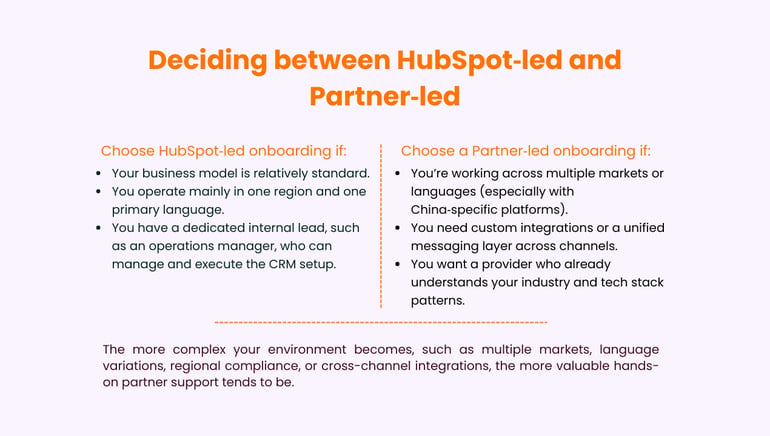
- Relatively standard B2B/B2C funnels
- Single‑region, English‑first teams
- Companies with internal operating teams who can execute
Limitations:
- More standardised and primarily advisory in nature
Framework may feel rigid if your business model is unconventional - Limited depth in non-HubSpot or regional integrations
HubSpot-led onboarding typically will not go deep into non-HubSpot integrations, custom middleware or highly niche regional platforms.
If you want a strong framework and your team can handle the execution, HubSpot‑led onboarding can be a solid fit.
Partner‑led onboarding
Delivered by certified implementation partners.
Strengths:
- Alignment with your revenue model
A strong partner is more likely to align your HubSpot plan with your specific business model. They consider your website, existing tools, data flows, and internal processes. - Industry and regional specialisation
Many partners specialise in certain industries, regions, or platforms e.g., cross‑border APAC companies, China channels like WeChat or XiaoHongShu. - Process redesign capability
Partner-led onboarding is valuable when you are not just installing software but redefining lead qualification, handoffs and KPIs across marketing, sales and service. - Troubleshooting assistance
Instead of guiding your team through fixes step by step, partners often diagnose and resolve workflow issues.
Limitations:
- Quality varies significantly
Experience, depth, and methodology differ a lot between partners. You’ll need to vet them. - Reduced internal ownership
If the partner handles most of the configuration and troubleshooting, your team may become overly reliant, limiting internal confidence and long-term ownership of the platform. - Greater cross-team commitment required
Partner-led onboarding is rarely a one-day exercise. It involves multiple workshops and decision checkpoints across teams. The additional time investment upfront often reduces rework and strengthens system adoption over the long term.
Partner-led onboarding is often more appropriate when you operate across multiple markets, require custom integrations, or are redesigning processes across marketing, sales and service.
As complexity increases, hands-on implementation support becomes more valuable.
Choosing the Right Onboarding Approach
The right onboarding route depends on your business complexity, internal capability and long-term growth plans. If you would like a deeper breakdown of how to evaluate providers, compare methodologies and assess fit, we cover that in detail here:
👉 How to Choose the Right HubSpot Onboarding Provider for Your Team
Ready to Get HubSpot Right From Day One?
If you are investing in HubSpot, the setup phase shapes everything that follows. Lifecycle definitions, reporting structure, automation logic, these decisions compound over time.
If you're unsure whether your setup is too simple for onboarding or already complex enough to need one, that's usually the tipping point most teams struggle with.
At NetFarmer, a HubSpot Platinum Solutions Partner, we specialise in onboarding for growing B2B and B2C teams across Asia, including multi-market and integration-heavy environments. A short conversation on HubSpot implementation can often clarify scope, risks and priorities quickly.
You can learn more about NetFarmer or schedule a call with our team here.
Updated as of 20 August 2026.
.png)