
For businesses trying to make a break into the China market, simply having a website and running ads is not enough. Chinese consumers spend their digital lives on local platforms,and WeiXin (微信) or WeChat sits at the centre of the ecosystem. They are the Number 1 messaging platform boasting over 810 million users in China alone, and a whopping 1 billion active users globally.
But beyond just Wechat, there is another platform that businesses utilise more often - WeCom (企业微信). The sister app to WeChat, WeCom is designed for businesses to manage conversations with personnel both within the organisation and external to their organisation.
Understanding how these two apps work together can help businesses build a more effective China market entry strategy.
What is WeChat?
WeChat is a messaging, social and digital services platform that has evolved into a super app. It combines communication, content, payments, search, commerce and services within one ecosystem.
Tencent reported that WeiXin (微信) (or WeChat) had more than 1.4 billion combined monthly active users as of Q1 2026.
For businesses, some of the most important features include Official Accounts, Mini Programs, Weixin Pay, Channels and Weixin Search.
This means a customer can discover a brand, read its content, search for information, interact with a business, access a Mini Program and potentially make a purchase without leaving the wider WeChat ecosystem.
Technically, Weixin 微信 is the version designed for users in mainland China, while WeChat is its international sister service. The two are interoperable, although businesses entering China will generally encounter the Weixin ecosystem, but let’s just stick to referring to them as WeChat.
What is WeCom?
Meet WeChat’s business-focused sibling, WeCom (企业微信).
WeCom is Tencent's business communication and workplace platform, designed to help companies communicate internally and manage relationships with external customers. The important difference is that WeCom is built around the company, rather than an individual's personal account.
WeChat and WeCom are two separate apps, but they are designed to work together. Think of WeCom as a professional extension of the WeChat ecosystem. While they have different purposes, WeCom connects with WeChat to help businesses manage customer conversations and relationships in a more structured way.
To make this clearer, imagine you get hired by a company that uses WeCom. You receive a company managed WeCom account, which you can use to communicate with colleagues and customers. Hence, your WeCom work conversations are separate from the chats on your personal WeChat account.
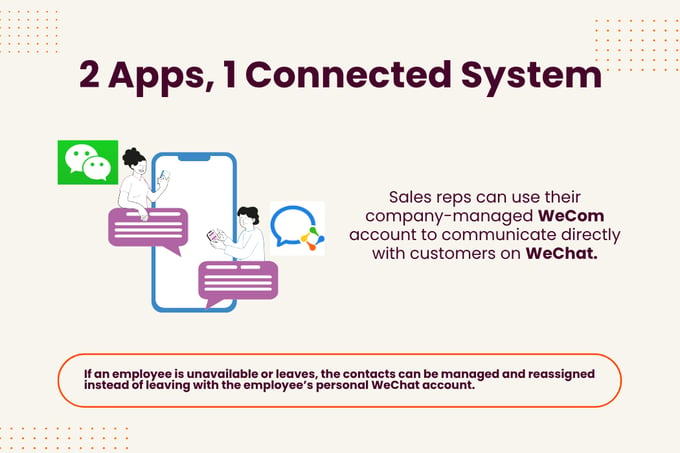
Here is where it gets interesting: your customers do not need a WeCom account to speak with you.
A prospect can continue using their existing personal WeChat account to communicate with your company’s WeCom account. That means when a prospect or customer on WeChat messages sales representative or customer service, they receive it in the WeCom work account.
It is a little like having separate email accounts for your professional and personal communications. Your work email belongs to the company, while your personal email belongs to you. The difference is that WeCom can do much more than messaging, with business tools designed around employee communication, customer management and workflows.
What can businesses use WeCom for?
At its core, WeCom functions much like Slack or Microsoft Teams for internal business communication. Its key differentiator here is the ability to also manage conversations with prospects or clients in one system. This is particularly relevant in China, where business communication is often more chat-first than email-first.
Don’t get me wrong here, email does have a place in formal, document-heavy communication and communication with international companies. But for fast, ongoing and relationship-based conversations, messaging platforms such as WeChat are often the preferred channel.
This creates an interesting challenge for businesses.
Sales representatives may build hundreds of customer relationships through their personal WeChat accounts, making those relationships closely tied to the individual rather than the company. However, giving them a company-managed WeCom account is a different story.
The organisation retains visibility and control over those customer relationships, so if an employee is sick for the day or leaves, the contacts can still be managed and reassigned instead of leaving with the employee’s personal WeChat account. Businesses can use WeCom for:
- Sales and customer communications
- Customer service
- Customer groups and relationship management
- Internal employee communication
- Business workflows and applications
- Integration with other business systems
WeCom also sits within the wider WeChat ecosystem. It can connect with WeChat, Mini Programs and WeChat Pay, while its APIs allow businesses to connect WeCom with their own applications and systems, including CRM platforms like HubSpot.
What is the difference between WeChat and WeCom?
1. Difference in ownership of contactsThis is probably the most important difference for businesses. Personal WeChat contacts are associated with an individual's account. The problem is that the customer relationship is effectively tied to the employee's personal account. If the salesperson leaves the company, you can potentially lose access to those customer relationships.
With WeCom, the salesperson is communicating through a company-managed business identity. The company can manage employees, customer contacts, customer groups, tags, conversations and integrations centrally. That makes WeCom much more suitable for sales, customer service and CRM operations.
2. Difference in interface and purposeBoth share a similar layout, the distinction comes from separating personal life and work use. WeChat is primarily built around personal relationships, so your contacts are typically friends, family, communities and brands. WeCom is built around work relationships, which allows for additional categorising based on the type of stakeholders they are. For example, colleagues, suppliers, distributors, prospective customers, clients etc.
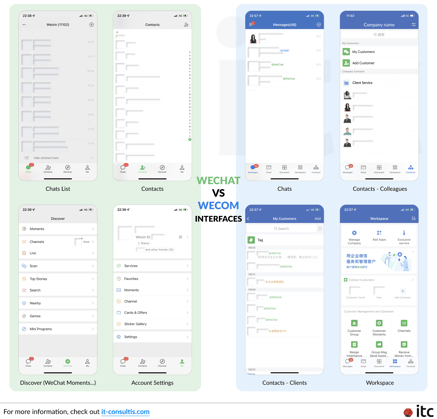 (Image source: ITC)
ales representatives may build hundreds of customer relationships through their personal WeChat accounts, making those relationships closely tied to the individual rather than the company. However, giving them a company-managed WeCom account is a different story. The organisation retains visibility and control over those customer relationships, so if an employee is sick for the day or leaves, the contacts can still be managed and reassigned instead of leaving with the employee’s personal WeChat account.
3. Difference in customer managementCompared to WeChat, WeCom provides business tools such as customer tags, customer groups and employee-level customer management, making it more suitable for structured sales and customer service operations.
4. Difference in business integrationWeChat provides businesses with tools such as Official Accounts, Mini Programs and Weixin Pay to engage customers. WeCom goes further into the operational side of the business, with APIs and integrations that can connect customer conversations and business activities with other systems, including CRM platforms.
How can businesses use WeChat and WeCom to enter the China market?
For businesses entering China, the biggest opportunity is not simply to "be on WeChat". It is to build a connected customer journey.
A practical approach could look like this:
1. Build visibility on WeChat.
Use Official Accounts, Channels and relevant content to introduce your brand to the Chinese market.
2. Give customers somewhere to take action.
Use a Mini Program or another appropriate WeChat touchpoint for enquiries, product information, bookings or transactions.
3. Move high-intent customers into conversations.
Use WeCom to allow sales or customer service teams to communicate with prospects and customers directly.
4. Connect the relationship to your CRM.
Integrating WeCom and other China-facing channels with your CRM can help sales and marketing teams maintain a more complete view of the customer.
5. Build for long-term engagement.
China market entry is not just about acquiring a customer. The goal is to create a system for continuing conversations, nurturing leads and delivering customer service locally.
Interested in charting your WeChat marketing strategy with us? Contact us today!
Why do WeChat and WeCom matter for China market expansion?
Entering China often requires more than translating an existing marketing strategy. Businesses need to understand where Chinese customers discover brands, how they communicate with companies and how relationships are managed after the first interaction.
WeChat provides the ecosystem for discovery, content and customer engagement. WeCom provides businesses with a more structured way to manage those relationships.
Together, they can form an important part of a China market strategy. To take it one step further, connect WeChat or WeCom to a CRM like HubSpot, to bring customer data, sales and marketing activities into one place.
%20(2).png)

.png)