Most CRM comparisons gloss over the one place manufacturers actually lose deals: the quote.
If your sales process lives inside spreadsheets, email threads, and half-approved pricing files, the CRM isn’t your main system. It’s just where deals go to quietly die after the real work happens elsewhere. If any part of that chain breaks, the customer feels the delay before anyone inside the business admits the process is broken. That is why CRM choice matters here, but only after the quoting workflow itself is understood.
Why does quoting breakdown in most CRMs manufacturers use?
The short answer: most CRMs were not designed around quoting as a core workflow.
In many manufacturers, the CRM holds the opportunity, but the quote is created somewhere else. That might be Excel, a shared drive, a PDF template, or a sales manager’s inbox. Once that happens, version control weakens, pricing slips, and approvals become harder to trace.
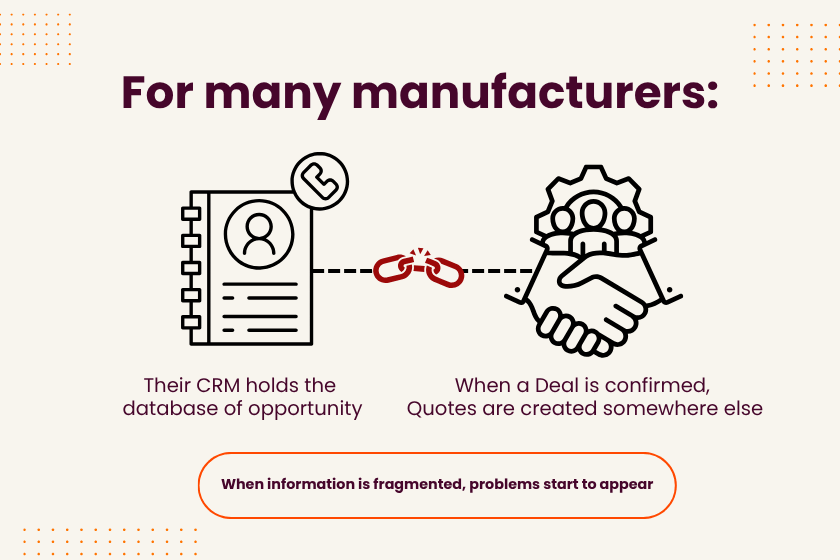
That creates three predictable problems:
- Sales teams lose visibility once a quote leaves the CRM.
- Pricing inconsistencies creep in across regions or reps.
- Approvals become opaque, slowing down deal velocity.
According to Aleran’s 2025 manufacturing survey, 86% of manufacturers reported losing deals due to slow or manual quoting processes, with approval bottlenecks cited as a key factor.
The fundamental mismatch is this: most CRMs expect you to enter a price, whereas manufacturing quoting requires you to calculate a price from raw inputs. When material prices change every week, a quote built on last month's steel cost may be unprofitable by the time the order is placed.
Most CRMs lack the cost-build-up model needed to pull current supplier pricing, estimate per-operation labour and machine time, and apply quantity-break pricing that amortises setup costs across volume.
The three quoting challenges that actually matter
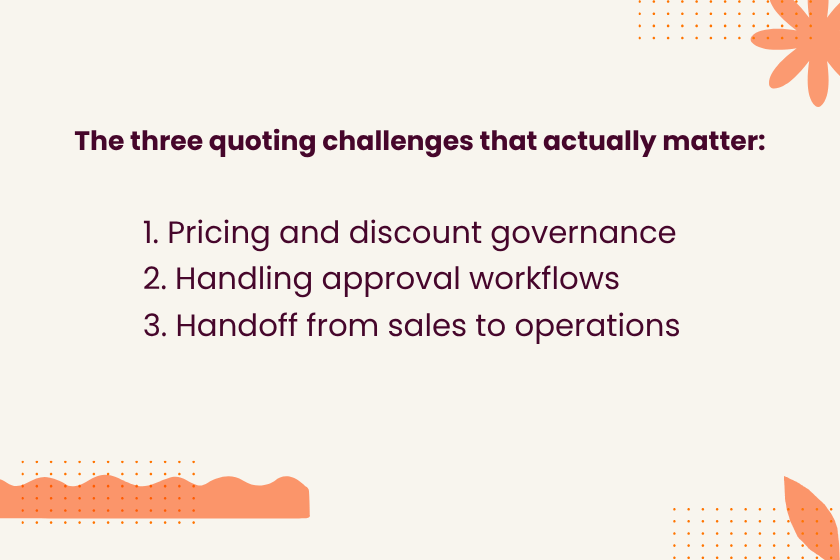
1. Pricing and discount governance
The first problem is not generating quotes—it is controlling them.
Manufacturers often operate with:
- Volume-based pricing.
- Customer-specific agreements.
- Regional price variations.
- Distributor margins.
Without guardrails, discounts become inconsistent. Two customers buying the same product may receive completely different pricing depending on the salesperson.
A CRM should not just generate quotes. It should enforce pricing logic.
In reality, many systems either:
- Lack flexibility (too rigid), or
- Allow too much freedom (too risky).
The balance is where most implementations fail.
2. Approval workflows that slow everything down
Approvals are where deals stall.
A typical manufacturing quote might require:
- Sales manager approval for discounts.
- Finance approval for margin thresholds.
- Operations validation for feasibility or lead time.
When these steps happen over email, no one has a clear view of:
- Who is holding up the deal.
- How long approvals are taking.
- Where the process consistently breaks.
A CRM that handles approvals properly creates accountability. One that doesn’t just adds another layer of confusion.
3. Handoff from sales to operations
This is the quiet failure point most teams underestimate.
Even when a quote is approved, the information passed to operations is often incomplete:
- Missing specifications.
- Outdated pricing versions.
- Verbal agreements not documented anywhere.
That leads to downstream issues—delays, rework, and strained customer relationships.
The CRM should act as the single source of truth, not just for sales, but for execution.
Final recommendations: Which CRM fits which manufacturer
The right CRM depends on how quoting behaves inside the business.
- Choose HubSpot if you want a cleaner quoting process, quicker adoption, and enough structure to keep quotes visible.
- Choose Salesforce if quoting is tied to strict approval rules, margin protection, and complex pricing logic.
- Choose Zoho if you are a smaller manufacturer and just need to formalise the basics without a large investment.
For a more detailed comparison guide between these 3 CRMs, refer to our earlier article: Best CRM for Manufacturers:HubSpot vs Salesforce vs Zoho
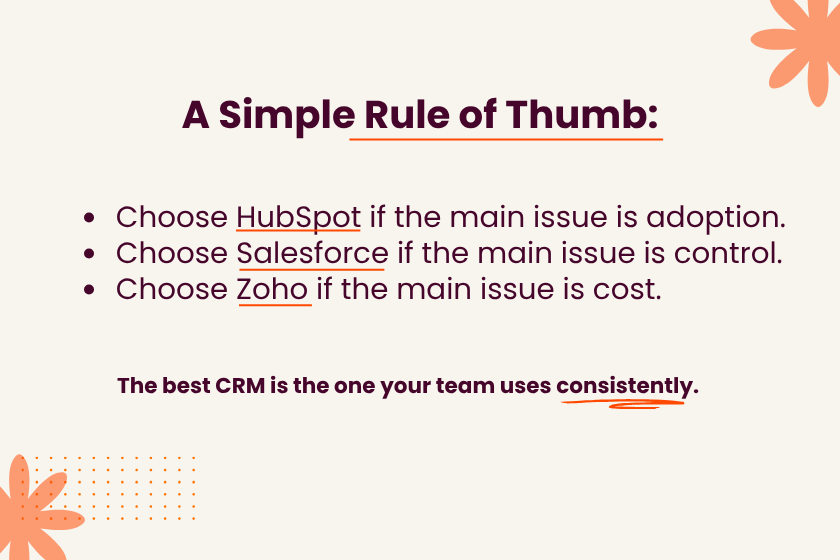
The key question is not which platform has the most features. It is which one your team will actually use when a quote needs to go out today.
Assess your quoting process before choosing a CRM
Most manufacturers do not have a CRM problem. They have a quoting process problem that the CRM exposes.
At NetFarmer, we work with manufacturing teams to map their real quoting workflows to fit HubSpot CRM, including discount rules, approval paths, and handoffs; all before implementing any system.
If your team is still relying on spreadsheets, manual approvals, or disconnected tools, it is worth reviewing your current process before committing to a platform.