How Do You Curate Your Prompt List For AEO Tracking?
Most teams get AEO (Answer Engine Optimisation) wrong at the very first step. They jump into content or tools without defining what they are actually measuring.
Prompt curation, or Prompt Engineering, determines whether your AEO programme produces insight or noise.
Coming up with prompts is easy. Asking the right questions is the hard part. If your prompt list does not cater to the important questions your business involves, your AEO data won't be useful.
In this article, we will be breaking down prompt list curation: Why your prompt pool may not correctly reflect your brand, what topics should your prompt pool include, and where can you find inspiration to get prompts that reflect real user queries.
When HubSpot built its AEO practice, their breakthrough did not come from publishing more content. It came from building a structured prompt library from hundreds of prompts, across products and buying stages. That shift turned vague visibility into something measurable and, more importantly, actionable.
What is an AEO prompt?
An AEO prompt is a real question a user might ask an AI answer engine that relates to your product or service. For example, “Which florist shop is the best in Singapore?” is a prompt.
HubSpot defines AEO prompts as the questions people ask when searching for brands or products in AI systems. These are not keywords. They are complete questions that reflect genuine intent.
Three characteristics matter:
- Question format. Not “Flower bouquet pricing” but “How much does a graduation bouquet cost in Singapore?”
- Real intent. The phrasing mirrors how users actually ask, not how marketers wish they would ask.
Think : "Where can I buy Ecuadorian roses with consistent head size?" VS "Where can I buy aesthetic blush themed wedding bouquets?"
Maybe someone who is an industry professional would search the former, but the latter captures how users will actually ask
- Direct business relevance. You can answer it, and the answer can reasonably connect to your offering.
What does "Prompt Engineering" actually mean?
Prompt Engineering is the practice of designing and refining instructions to guide AI models, like large language models (LLMs), to generate highly accurate and useful outputs.

In this case , we use it to curate our prompt list; building a deliberate, structured set of real user questions to track across AI engines.
This is not brainstorming. It is selection, validation, and organisation.
A well curated prompt list does three things:
- Defines what “visibility” means for your business
- Surfaces where you are losing to competitors
- Reveals which content actually influences AI answers
If your prompt list is shallow or skewed, your entire AEO dataset will be misleading.
Why do most prompt lists fail?
Most prompt lists fail because they are either too generic or too narrow.
A typical mistake looks like this:
A firm providing SaaS HR software in Singapore may track prompts like “What is HR software?” and “Benefits of HR systems”. These are awareness level questions in AI answers, which rarely mention businesses or brands in your specific niche. Hence, your brand visibility in these prompts are often low to zero.
The more important commercial questions to your niche are missing here:
- “Best HR software for SMEs in Singapore”
- “How much does HR software cost per employee?””
- “(Competitor brand) vs (Your SaaS HR software) for Singapore companies”
Across all of these, the pattern is consistent. Awareness questions are overrepresented because they feel safe and familiar. Decision-stage questions are underrepresented because they require specificity and commercial clarity.
Users on AI search tools are usually searching high-intent prompts, specific to their situation. It means deliberately including the uncomfortable, high-intent questions where comparison, pricing, and commitment are explicit.
What principles make prompt design work?
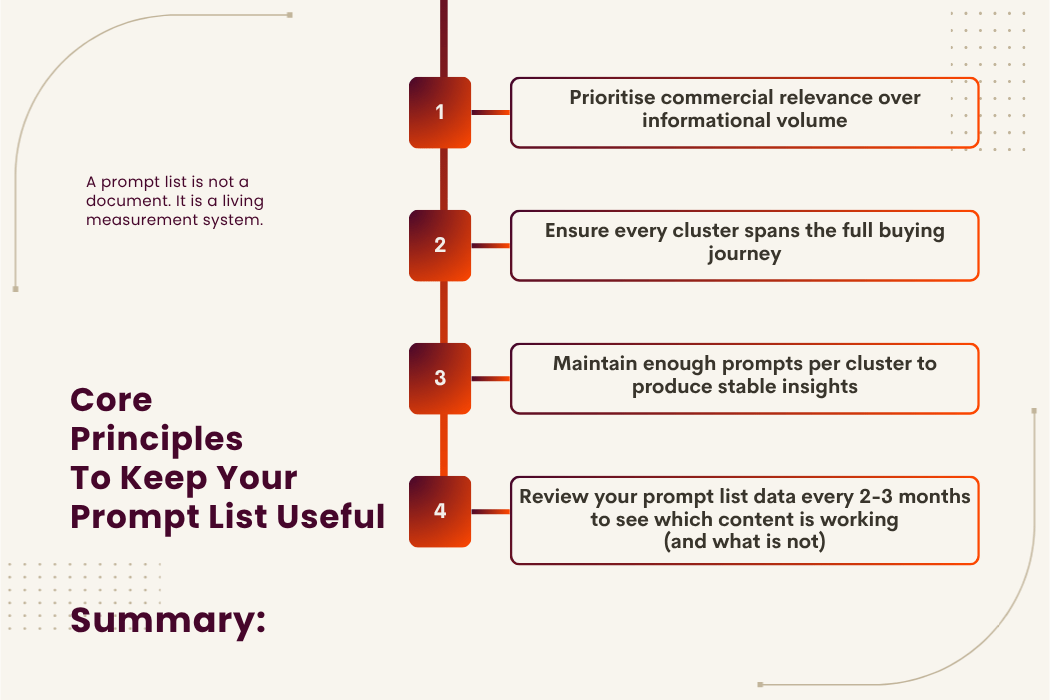
The most important rule is coverage. Users ask different questions at different stages, so your prompts must span all of them.
HubSpot helps to map the four buyer stages in their AEO dashboard:
Case Study: We had a high mix, low volume paper product manufacturer come to us for consultation on AEO. They make a wide range of paper based products in relatively small batches. Their business often handles custom orders, different specifications, and frequent changes in size, material, print, or finish.
- Awareness:
Broad, problem led questions such as: “What are the different types of paper used for food packaging?”, “Are there manufacturers who can produce sustainable packaging?” - Consideration:
Non-branded comparisons such as: “Which paper packaging is better for wet products?”, “What is the difference between kraft paper and coated paper for gift boxes?” - Evaluation:
Brand specific fit questions such as: “Is [manufacturer name] suitable for custom paper packaging?” or “Which paper supplier can handle small batch custom orders?” - Decision:
High intent, product focused queries such as: “How long does custom paper packaging production take?” or “What is the minimum order quantity for printed paper bags?”
If you have only awareness stage prompts, you will miss out on buyers with higher purchasing intent. Oftentimes, it is smarter to include a healthy portion of Consideration and Evaluation level prompts if your business is a niche, as that is usually where decisions are being made.
Where good prompts actually come from
Strong prompt lists are grounded in real behaviour, not internal opinions. Use real data, not workshop guesses. Do not sit in a meeting room discussing and inventing prompts.
The most reliable sources are:
- Sales conversations: The questions prospects ask before they buy are your highest value prompts.
- Customer support tickets: These reveal friction points and feature-level intent
- Website search data: This shows how users phrase problems in their own words
- CRM data and segmentation: Data from your CRM logs, such as industry, deal stage, and competitor mentions all shape prompt relevance
- AI-assisted generation: Tools like HubSpot AEO can expand a seed prompt into realistic variations based on your data
- Competitor analysis: When competitors appear in AI answers, what questions are being answered?
How to set up a high quality prompt list?
The most reliable way to curate prompts is to organise them across two dimensions: topic clusters and buying stages.
1. Start off with 3 to 5 core topic clusters
Each cluster represents a commercially meaningful theme.
For example, if you are providing educational services in Singapore:
- Tuition Services for Primary school students Singapore
- Best tuition centre in Singapore
- Best tuition teacher for Math Singapore East Area
These are not content ideas, they are tracking containers in areas that you want to be seen in AI search.
2. Map prompts across the full buying journey
Each cluster should include prompts from all four stages:
- Awareness: “What is CRM software for small businesses?”
- Consideration: “HubSpot vs Salesforce for SMEs in Singapore”
- Evaluation: “Is HubSpot suitable for manufacturing companies?”
- Decision: “HubSpot implementation cost Singapore”
If one stage is missing, your dataset has a blind spot.
In practice, most teams over-index on awareness and under-invest in decision-stage prompts, which is where revenue actually sits.
3. Aim for 20 to 30 prompts per cluster
AI-generated answers fluctuate between each generation.
Once we consolidate a substantial amount of prompts per topic, we can ensure a few things:
- Measurement stability: AI answers fluctuate. A handful of prompts gives a distorted picture.
- Intent coverage: Each topic includes definition, comparison, evaluation and decision queries.
- Gap discovery: Small samples tend to overrepresent your strengths and hide your weaknesses.
Think of it like soil sampling. Five samples will not tell you how the whole field performs.
A handful of prompts will cause your visibility to swing wildly based on small changes. Widen that pool and patterns become visible, outliers matter less, and gaps are easier to diagnose.
4. Include a mix of Branded VS Non-Branded prompts
Branded Prompts are prompt questions that include your brand name.
In the earlier example, “Is [manufacturer name] suitable for custom paper packaging?” is a branded evaluation level prompt.
Including a small mix of these prompts will let you know how AI search platforms are actually describing or rating your brand. Usually a few or a handful of them is enough for you to check visibility (10-20% of your prompt library), just be sure to tag them as branded so you can exclude them if you wish to see your accurate brand visibility.
How Can I track AEO prompts?
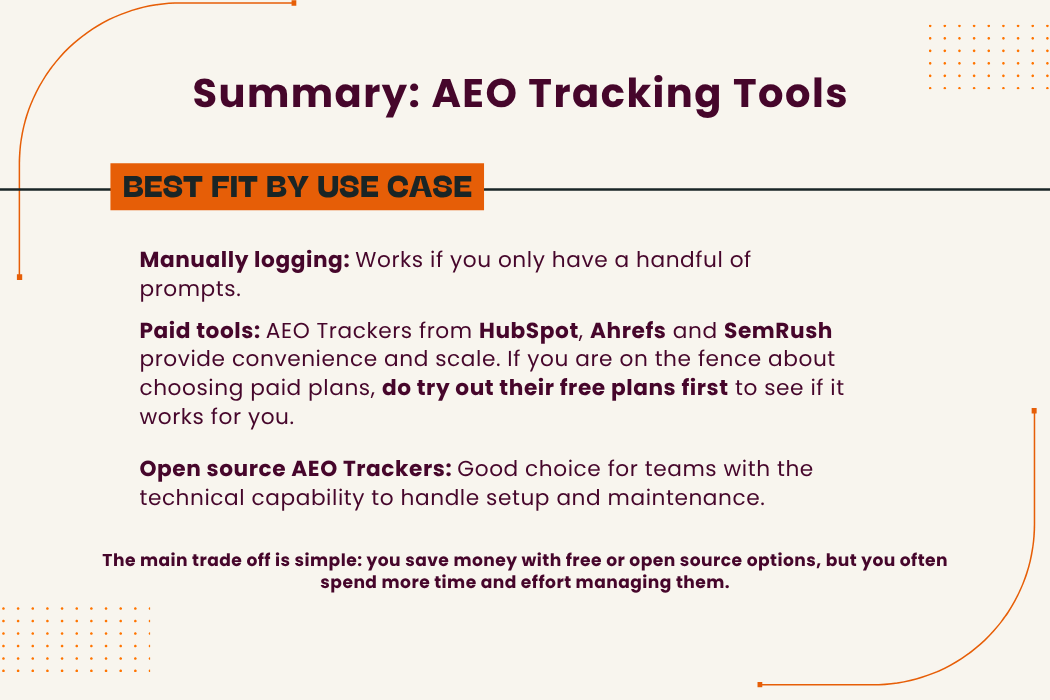
- Manual checking: This setup will work if you only have a small prompt pool and want a quick read on how AI responds, but it becomes inefficient once you are tracking many topics, industries, or buying stages.
- Dedicated AEO tools: Such as HubSpot’s AEO Tool , SemRush AEO tracker, Ahrefs and Profound are the easiest way to save time because they automate prompt runs, store historical data, and show changes in visibility, citations, and competitor presence over time.
Free plans can be useful when getting started, but they are often limited in coverage, tracking depth, or number of prompts. They are good for testing, not serious ongoing measurement.
Paid plans usually give you broader coverage, more reliable tracking, and less manual work. If you need repeatable reporting and trend analysis, they are usually worth it. - Open source or API based tools: These can be a strong option if you have a team with the technical skills and prowess, (or can at least understand coding) and want more control over how prompts are tracked. They can be flexible and cost effective, but setup is usually more complex.
Take caution when using these, because not every repository is well maintained or safe. Check the source carefully, watch out for fake links, and avoid downloading anything that looks unreliable. Also, some may say they are free at the start, but require fees to upgrade once you hit a wall in usability.
Summary: Best fit by use case.
What HubSpot does differently
One reason HubSpot’s approach scales is its use of CRM data to shape prompt generation.
Instead of guessing, the system pulls from:
- Industry segments
- Known competitors
- Customer profiles
This produces prompts that are closer to real buying scenarios.
It also closes the loop. Prompt performance feeds directly into content recommendations, which can be executed inside the same platform. That removes the usual disconnect between insight and action.
Try HubSpot AEO Tool for free today!